On this chilly Saturday, seven volunteers (including myself) gathered at the Urbanspace Gallery at 401 Richmond St. W. to participate in a "psychogeographic" walk of some of the neighbouring streets.
This was the latest in a series of walks that had already taken place in New York City, Berlin and Mumbai, to measure ordinary peoples' emotions and reactions to the urban environment. You can see their website at psychologyonthestreet.com.
The study was being conducted by Dr. Collin Ellard and some students from Waterloo University. We were greeted by one of the students at the Gallery, and given electronic devices to wear. One was worn like a headband, and measured brain activity, like an EEG. It even measured our eye-blinks! The other was worn like a wristwatch, and measured things like pulse and body temperature.
These were to gauge autonomic responses.
We were also given an Android device, much like a smartphone, on which we were asked to record our conscious reactions to the places we looked at, by answering questions (on a 1-to-5 scale) like "How old is this area?", "How safe is this area?", "How much traffic is in this area?" etc.
Each place was chosen according to a few factors, like density, age, noise level, traffic, and so on.
Our first stop was at the intersection of Queen W. and Portland St., where we took in this view:
As with each stop, we were given one minute to study this area, then asked to answer the questions, as I mentioned above.
The next stop was this alley looking south to King St. W.:
Then, on to this view of condos along Stewart St., near Wellington:
Next was Clarence Square, at Spadina and Wellington, looking a little drab this time of year:
Our next stop was a parking garage near a couple of construction sites, on Peter St. south of Richmond, where I didn't get a picture...
...then it was back to Richmond & Spadina, where we were instructed to take a look west at the intersection:
We had done our tasks as instructed at each stop; by the time we got here, it was starting to get quite cold, and we were glad to be able to get back indoors.
Once back inside the Urbanspace Gallery, we were "debriefed" by our guide, and encouraged to give comments or ask questions. It had been a good learning experience for all of us.
It is to be hoped that the results of these studies will be shared with urban planners and developers, so that future urban spaces can be created in ever-growing, ever-changing cities - that take into account the positive (and negative) ways their citizens react to the place they live in.
For my part, I realized at one point that I don't really know this city that well, after all, and felt quite humbled. We passed by independent coffee shops, pubs, restaurants and stores that I'd never seen, or even heard of.
It made me realize how often, when I spend time walking around downtown, that I stick to major streets like King, Dundas, Queen, Bloor or Richmond, and not lesser-known streets that may well yield small rewards, like an undiscovered shop, or a breathtaking view of the skyline.
Fall has arrived (did you set your clock back last night?), and with it comes an explosion of colour as our deciduous trees shed their leaves for the coming winter.
In downtown Toronto, there aren't too many places where you can get the most spectacular colours; for that, you need to go to the Rouge Valley, or right out of town altogether. As time goes by so quickly these days, it seems like there are only a few days of colourful leaves in the city, then whoomph! they're all on the ground.
Nevertheless, there are some amazing shows to be had south of Bloor St., if you slow down and look closely. There don't have to be blazing oranges or reds in order to catch your eye.
Let me show you what I mean:
First, looking south from the Prince Edward Viaduct over Rosedale Valley Road, there are some nice varieties of colour, from green to a deep orange:
Pix taken with smartphone, but colours came out quite nicely!
And farther along in the same valley, more colours. I was particularly taken with the leaves at right just nicely turning from green to yellow, and the reddish-pink of the ones in the centre:
Right near Castle Frank subway station is this brilliantly yellow maple tree...
And, even though I was essentially shooting blind through the "Luminous Veil" over the Don Valley, I still got a good shot of some great orange/rust/red colours along Bayview Ave., south of Bloor:
Finally, in Withrow Park, a couple of more maples going from yellow to orange:
You can see how quickly the leaves are falling here, so, yes, there is just a small window of time available to see these things, and to get a few snaps.
Like I said, Algonquin Park it ain't, but if you "go placidly amid the noise and haste," and just simply stop and take a look around, you will often see beautiful things right in front of you.
At Fort York here in Toronto, there is currently an exhibit celebrating the 800th anniversary of the signing of the original Magna Carta in June of 1215.
As you may know, the Magna Carta (Grand Charter) was a document discussed, agreed upon and signed by King John and a group of "rebel" barons, who felt the king held too much power over his subjects. It limited the king's powers, and introduced many legal rights that we are very familiar with (and even take for granted) today. These included the right to a trial by a jury of one's peers, the right to a speedy trial, and the concept of habeas corpus, among others.
Now, these rules didn't apply to everyone. The document makes reference to "free men," which meant the upper classes, like lords and barons, and not the peasants over whom these people still held power. As time went by, though, the rules came to be applied to every citizen of a country.
The Magna Carta has been the starting point for almost every modern constitution and bill of rights that we know today, including those of France, The United States, and Canada, as well as the UN's Universal Declaration of Human Rights.
The Exhibit
The first part of the exhibit is a video introduction by HRH, Prince Charles, who talks about the signing of the document, with particular reference to how it's relevant to modern Canadians. There are comments by noteworthy Canadians such as Kim Campbell and Frank Iacobucci. There are also some animated sequences explaining the background and culture of the time of the Magna Carta, narrated by another noteworthy Canadian, national treasure Gordon Pinsent.
Then it's on to the documents themselves. The actual 1215 Magna Carta is not in this exhibit (King John signed it, then, with the help of Pope Innocent III, proceeded to summarily ignore it, and there are only a few copies extant.) This exhibit includes a year 1300 copy of the document that normally resides at Durham Cathedral in England, as well as a copy of the Forest Charter.
The Forest Charter set out rules for land usage in England, as woods and their related activities, like hunting and trapping, were a crucial part of life for anyone in the Middle Ages.
We were allowed to take pictures of these documents, but only without flash on the camera, and without leaning over the temperature- and light-controlled glass cases they were enclosed in. So these aren't the greatest pics, but the documents are the real thing.
First was the Forest Charter:
Then, the 1300 version of the Magna Carta itself:
As you can see, the documents have been folded and re-folded many times. They are written with extremely small, though beautiful, calligraphy, and are in Latin, the formal language of the day. They both include the king's seal, which was made with a stamp in hot wax, and had the same meaning as a signature does nowadays.
I don't mind saying that it was pretty awe-inspiring to be able to look at these ancient documents that are so very important to everyone.
There were also electronic representations of each of these documents, that you could enlarge in order to see the document better. With the press of a button, you could also see the document in an English translation, with an interactive glossary to explain such terms as "scutage," "wapentake" and "novel disseisin."
Here are the electronic versions, first of the Magna Carta:
You can see the same "king on horseback" seal as the original document.
And the Forest Charter:
The rest of the exhibit included text relating to more modern documents that would have been inspired by the Magna Carta, as well as quotes from figures like Franklin Roosevelt and Nelson Mandela, that referred to the universal human rights that it espoused.
A very cool part of the exhibit was a large world globe that you could move an e-reader around and highlight different countries' constitutions and bills of rights throughout history. It's surprising how large a span of time there is between the earliest of these documents (the U.S., France and Denmark, all in the 18th century) and the most recent (Germany and Japan, after the Second World War).
The last part of the exhibit covers Toronto itself, and the recent advancements in human rights that have happened, most notably gay rights. There are text and pictures of events that have occurred, probably, within most peoples' living memory, starting with the massive police raids on Toronto bathhouses in the early 1980s.
There is also a reference to the first gay marriage, where, if you can picture it, the minister was issued a bulletproof vest by police prior to performing the ceremony.
Conclusion
I was very happy to be able to see these ancient documents in person. I felt obligated, actually, as a fortunate citizen of one of the most functional societies in the world today, to pay my respects to these forward-looking, and still relevant, pieces of history.
(I was also inspired enough to buy a two-by-three foot poster of the English translation of the Magna Carta as a souvenir.)
As a great man said, the price of freedom is eternal vigilance, and rules like these are never to be taken lightly, or - worst of all - forgotten.
This year marked the 10th year for the Nuit Blanche celebration in Toronto. I've been to most of them, though not all. I've seen it grow from a smaller series of installations (that were often widely spaced out, and frankly, a little hard to find) to the well-run, easier-to-follow party that it is now.
I suppose it is possible to see all the pieces in one 12-hour period (and if you have, well-done), but I've usually chosen a narrower path that I could walk in a few hours, based partially on pieces highlighted/recommended in local media. Who knows what I've missed as a result, but a person can only do so much! As it is, I am usually quite exhausted by the time I call it quits (not a kid anymore).
This year, I checked out the Nuit Blanche website, and decided to follow a roughly L-shaped path (okay, maybe more of a zigzag), starting from Dundas & McCaul, and ending around Queen's Quay & Parliament. I have lots of pictures, though not of everything.
The Journey
My first stop was at St. George the Martyr church, off McCaul, and a piece by Mary Ma called Reverence In Reverie, an image of blue skies projected onto a circular screen suspended in the middle of the room.
Then it was on to the TIFF Bell Lightbox, where I ended up spending most of three hours sitting (very welcome) and enjoying several pieces, the first of which was called LIKE/COMMENT/SUBSCRIBE, a collection of strange, quirky or humourous videos posted to the internet over the years:
This was literally an all-night program, every hour on the hour, with different postings being played each time. So you could have stayed there all night if you wanted!
Other pieces there included KINO-BLENDER, a darkly humourous mashup of trailers, scenes and dialogue from movies over the years, that went about an hour.
Another piece was called Gauge, a time-lapse film taken in Canada's lower Arctic, with a group of artists painting indigenous-themed scenes on walls of ice and snow that seemed to rise from the tundra, then sink again.
There was also a fun piece called Pixelate, where participants could perform some activity against a background. These would be filmed, then pixelated, to resemble an old-school video game.
Here's a photo of it that better illustrates what I mean:
As I said, this visit took some time.
Next, it was over to David Pecaut Square for this installation by Stefan Verstappen, called Tri-monic: Shape, Sound, Sight. Passersby were invited into this circle of three lit-up plinths to play a keyboard or stringed instrument, or sing or speak into a microphone. The sounds were amplified and distorted into a kind of sound collage.
Along the way to the next piece, I was struck by this installation, by Friends With You, entitled Light Cave. As you can see, it's a polymorphous piece of stitched-together, inflated canvas, lit from within. People were invited to walk through, talk to others, take photos or selfies, or whatever they wished.
The next piece was very cool. It was by the software company Architech, and called The Face of Toronto. People lined up and got their picture taken, which was then mapped (as you see in the pictures), to be made into a series of faces that would morph from one to another, to reflect the diversity of Toronto's citizens. The finished project is supposed to be available on the company's website.
In case you're wondering, there was a long lineup, so no, I didn't get my pic taken. Here's the link, though (copy & paste): http://www.architech.ca/#/labs/nuit-blanche2015
Then, it was on to the Tundra Restaurant at the Hilton Hotel at University & Richmond, for a fascinating piece by Maziar Ghaderi called Mirada: Holographic Fire X Interactive Technology. When I arrived, there was a native poet, Duke Redbird, reciting a poem as people sat on banquettes around the perimeter of the room, and electronically-enhanced sounds of nature played. You can see Mr. Redbird, with microphone, just to the right of centre in this picture:
What was striking about this piece was that there was no actual fire; What appeared to be flame in the central glass piece was actually reflections of projections in each of the four monitors around it, giving a "holographic" effect:
Then, up to Nathan Phillips Square for a very ambitious project by JR called Inside Out. Once again, people were invited to have their picture taken, and the photos were enlarged and displayed on various surfaces around the square, as in this picture, where they're on the now-iconic TORONTO sign:
Enlarged pictures were also being pasted to the concrete of the square itself...
...as well as to the wall of the ramp up to the rotunda level:
And, here is the view from the rotunda level of the whole thing. It's hard to tell in the dark, but it almost seems to be in the form of a maze.
At top right, you can see the photo booth (oddly enough, called "photo booth") where people got their picture taken. As you may have noticed by the pictures, it seems like they were encouraged to use whatever facial expression struck their fancy!
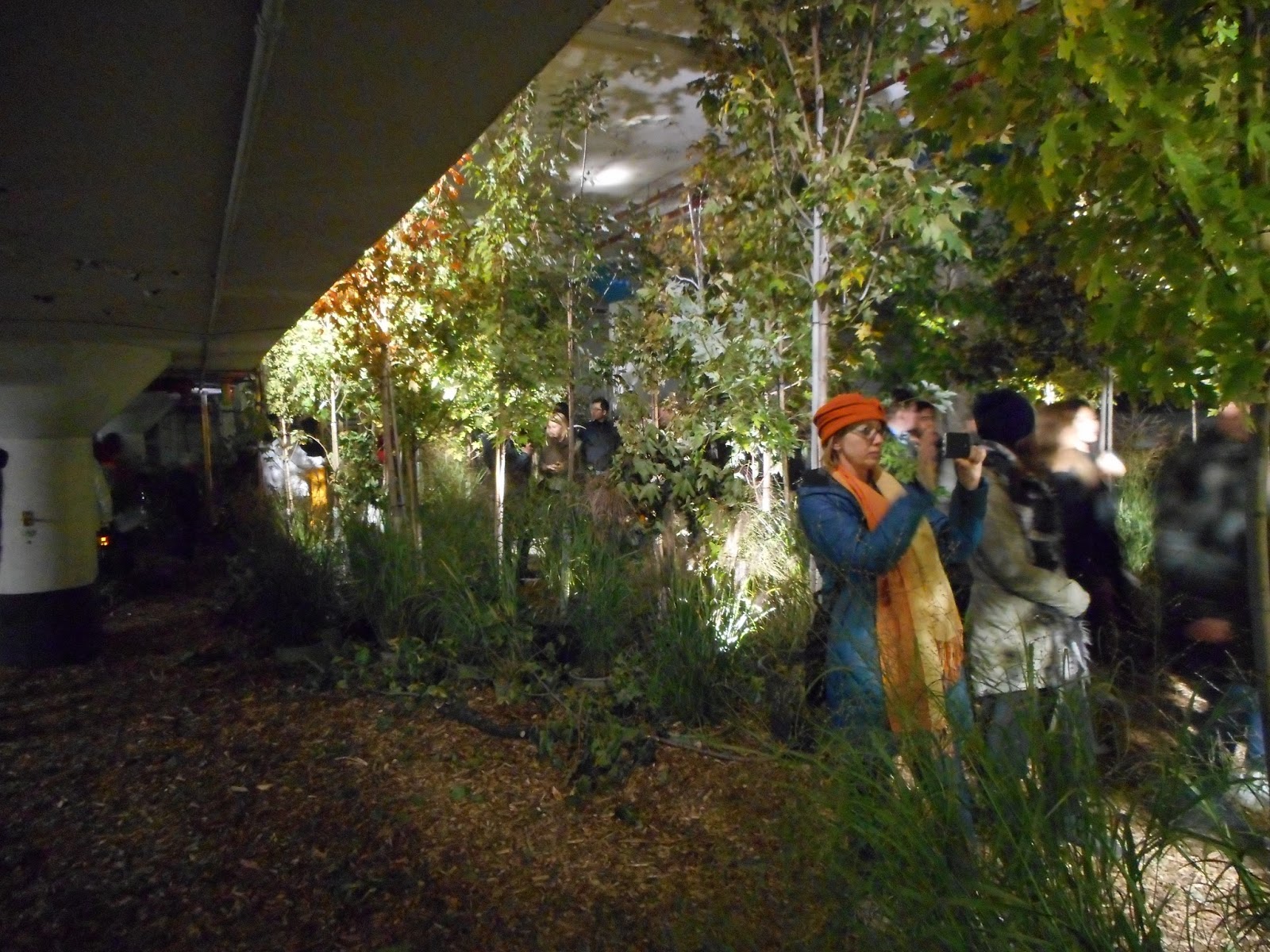
The other very striking installation at the square was called Park Here, by Katy Chey. It plays on both meanings of that title (i.e., park your car here/here is a park), and the artist created a parklike environment right in the city hall parking lot.
I loved the contrast between the drab, mundane poured concrete of the parking garage and the green trees, bushes, and wood-chip flooring of this installation.
The next stop for me was the gazebo at St. James Park at King & Church, to see a project by a group called the Department of Imaginary Affairs, entitled The East Side Story. It was a giant, six-page book, laid out on the floor of the gazebo, with writings and photos by residents of Toronto's east end.
It looked like "East End" was fairly broadly defined, as there were testimonies from people in the Cabbagetown, Leslieville, and Beach areas, among others.
You could also write a personal message on a large piece of canvas, which, as a long-time resident of the east side, I did.
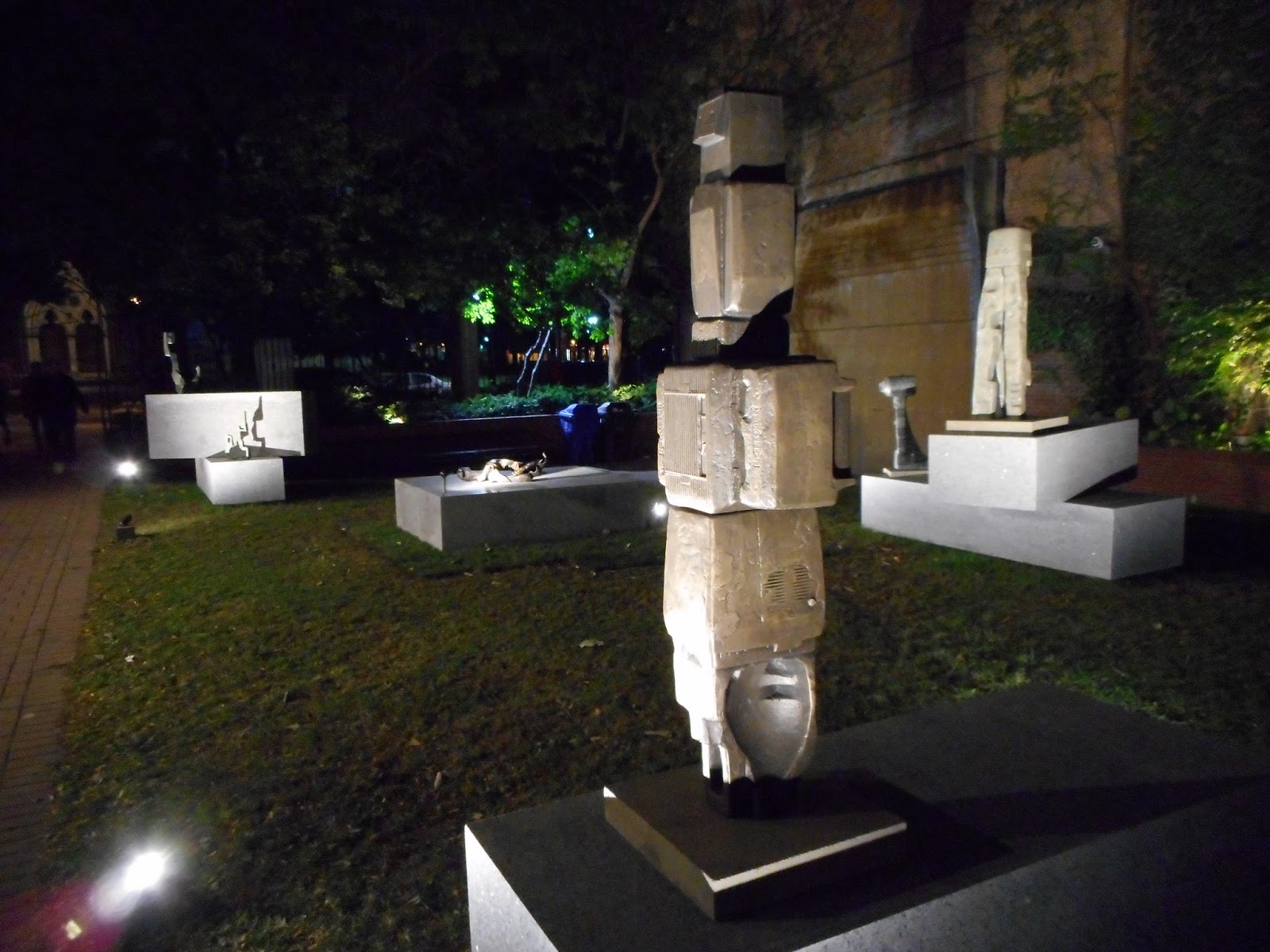
Across the street, at the Sculpture Garden, was a piece by An Te Liu called Solid States. The artist took found pieces, cast them in bronze, and made abstract sculpture with them. It seemed like many of the pieces originated from styrofoam packing material.
A couple of the pieces were decidedly anthropomorphic in nature, as this closer look at the one in the foreground of the above pic will demonstrate:
Then, it was down (and back) to Union Station, where there were a couple of installations, including this colourful fabric piece by Amanda McAvour, called Pattern Study:
On the way south from there, there was this interesting/eerie/unsettling piece by, once again, JR, projected on the Union Station overpass, called The Eyes of the Bridge. The eyes were in constant motion, as if watching passersby.
Down at Waterpark Place was this sound installation by Marguerite Humeau. It was part of the "Beaufort" series for this night, and is called called Screams From Hell, actual sounds that emanate from the earth's crust (no, no, not the people talking, the eerie tones in the background):
Further along Queen's Quay, at the Westin Harbour Castle hotel, was this amazing piece, also part of the "Beaufort" series. It's by Los Carpinteros, and is called Frio Estudio del Desastre. It simulates the moment of impact of a shell on a concrete-block wall:
I couldn't resist taking a shot through the hole in the wall (actual cinderblocks, by the way) from the other side:
What a breathtaking piece of work!
Continuing along Queen's Quay, another in the "Beaufort" series, this one called Hit, by Christof Migone, in which performers (in this picture, two people in a trailer) made sounds by striking a microphone against various surfaces, or by vocalizing...
...which were then transformed/processed/mutilated into this incredible collage of noises by a DJ/mixer:
Next was another "Beaufort" piece, by Heather & Ivan Morrison, called The Cleaving, large piles of logs which people could walk through:
Then, there was another highlight of the night, another "Beaufort" piece, by Robert Wysocki, called Lava Field, actual lava produced by melting rock in a coke-fired furnace and allowing it to flow over the ground outside the Lakeshore campus of George Brown College.
You could feel the heat off this thing, though it was cold and windy on the lakeshore. Sparks were flying everywhere, and I even got a small one in my eye! No damage, though.
Yep, real lava.
There was another piece along Queen's Quay, another of the "Beaufort" series, called Dispersal Zone. The artist, Tim Knowles, used generators to pump a substance through the streetlights that emitted a cloud from each one. As you can see, the effect was quite striking, with the wind blowing the clouds in every direction:
Finally, there was this fascinating work by Tomas Saraceno, the first of the "Beaufort" series, called Cumulus. It was a projection against the Victory Soya Mills silos, and was a very slow-moving series of changing cloud patterns. A few sequential shots might be the best way to show how this worked:
Well, that was all the exhibits I took in for this year. As a capper, I turned around from that location (Queen's Quay & Parliament) and took the final pic of the night, of Toronto's ever-changing skyline. Then it was on to the streetcar and home, just after 2 a.m.
In Summary
This was a rewarding night, as Nuit Blanche usually is.
Whether we acknowledge it or not, we rely on artists, of any type, to help us see things differently, to take us away from the mundane for a while. If our eyes are opened, our perceptions challenged (and hopefully changed), and if we have a little fun along the way, then the efforts of these people will have been worth it. They are to be congratulated.
I watched all three seasons of this extraordinary series, and I must say, it's unlike anything I've ever seen on regular network TV. Cable, yes. NBC? Good for them!
The show was developed by Bryan Fuller, known to me previously for an equally odd/fascinating cable series, Dead Like Me.
The plotline borrows liberally from the Hannibal Lecter books by Thomas Harris, particularly Red Dragon and Hannibal. But those are only its basis; the stories go much deeper into the characters of Will Graham and Hannibal (or any of the characters, for that matter) than any other adaptation has.
It's really remarkable that this series held on for as long as it did, considering that it contains some of the most gruesome scenes I've seen in any visual medium. There is an amazing amount of both physical and mental torture portrayed. But, as with the proverbial accident scene, I simply couldn't help looking (the same fascination that kept me glued to the extremely intense Oz through its entire run), and the show has apparently garnered quite the cult following.
But there are other qualities which kept me interested. Here are some of them (beware of spoilers):
The Casting
The cast is truly an international one, starting with Dane Mads Mikkelsen in the title role. Here he is in a publicity shot, wearing one of the immaculately tailored suits sported by the character throughout the series:
I confess to being rather baffled at first by the choice of this actor to play the part so memorably portrayed by both Brian Cox and Sir Anthony Hopkins. But the inscrutable mask of Mikkelsen's face turned out to be surprisingly suitable for this enigmatic character. Using his own accent, but speaking impeccable English, he performs Hannibal as tightly controlled, disciplined and classy. Therefore, the moments when he does become violent, or is injured himself, are that much more shocking.
I also liked the casting of Brit Hugh Dancy as Will Graham, a character also well-played by William Peterson and Edward Norton. With no trace of his original accent, and looking perpetually disheveled, he plays Will as someone so torn up by the things he sees that he's barely able to function in normal society.
This question is raised regularly throughout the series: with his visions and horrific experiences, how can he possibly lead a regular life? In the end (spoiler alert), he chooses death.
Another interesting casting choice was having black actors play characters not originally conceived (or imagined) as such, and having female actors portray characters who were male in their original incarnations.
Thus, we have Laurence Fishburne playing the CIA's Jack Crawford; beautiful Rutina Wesley (from another unusual series, True Blood) playing the blind girl Reba, romanced, and menaced, by Francis Dolarhyde (aka Red Dragon); and sleazy tabloid reporter Freddie Lowndes as a woman! Well - why not?
The Music
This was another aspect unique to this series; the very strange, atonal, unsettling music by Brian Reitzell.
A percussionist in known rock bands (including Red Kross), Reitzell uses synthesizers, percussion, electronics, and yes, some regular instruments, to create tension and unease to match that already onscreen.
I've heard a piece off his album, Auto Music, and it's a combination of ambient, electronic and trance that has its own attraction.
I'll certainly miss that swooping, moaning synthesizer theme music every week - I kind of looked forward to it!
And finally, a topic I've discussed before on this blog:
Toronto Plays Every City
(and Ontario plays the countryside)
If Hannibal's residence/office In "Washington, D.C." looks familiar, it's because it's actually this handsome Georgian mansion on Simcoe St., south of King W., and across from Roy Thompson Hall:
The buildings around it are CGI'd out of course, to give the impression that it stands alone on the street. Often, there's a "star-field" effect in the background. But they make no effort in certain shots to disguise or mask the castle-like southwest tower of the adjoining St. Andrew's church, giving the building (deliberately, I'd say) a "fortress" aspect. You really don't want to know what goes on in there!
There are also many exterior scenes in this series, and I'm sure most of them are shot in the Ontario countryside, though they are supposed to be in Maryland or Virginia (they are also almost always in winter, which only adds to the otherworldly nature of the show). There's just something about the look of the sky, trees and air of exurban Ontario that can't be mistaken.
Conclusion
There are many more things about this series that I was intrigued by:
The very dialogue the characters speak is odd; mostly strangely formal, but sometimes throwing in cliches or slang. It (as well as the character speaking) is usually polite. calm and understated, though the statements can be accusatory or angry; characters almost never raise their voices. It must have been a bear to write an episode!
As I said at the top, the series is sometimes appallingly gruesome, with human bodies cut, sliced, ripped or torn in the most horrifying (if creative) ways. Oh, and did I mention the cannibalism? No? There's that, too. You never see these acts being carried out, though - only the results, though they're no less disturbing for that.
And then, there's the question of what's "real." Will Graham has so many "vision" or "dream" experiences that then snap back to reality, that you're never quite sure about what you're seeing. Also, characters (well, mostly Will) are terribly butchered or injured, and seem to take no time at all to heal, though time apparently passes.
The season/series finale is also enigmatic. Spoiler alert again: After teaming up with Hannibal to finally "slay the (Red) dragon," Will then hurls himself and Hannibal off a high bluff, and into the crashing surf below.
Are they both dead? Is one of them dead? Neither? Is it a riff on the "Reichenbach Falls" scene in the Sherlock Holmes stories, and there will be a resurrection?
Or - has the whole series been one of Will's visions?