Sunday, 15 May 2016

Jane's Walk - May 7, 2016

This cloudy Saturday was the first time I had participated in any of the Jane's Walks that take place this time of year in cities all over the world. The event has grown to such an extent that this year, there were no less than three days' worth of walks, on Friday, Saturday and Sunday.

If you're unfamiliar with Jane Jacobs (and I claim very little knowledge myself), she was a writer and thinker whose book, The Death and Life of Great American Cities, became a large influence on urban planning in the 1960s, mainly in the two cities she spent most of her life in, New York and Toronto. I haven't read the book myself, but from what I understand, it was a plea to conserve the history of cities, rather than simply demolishing whole neighbourhoods or buildings to make way for new things. Please feel free to correct me, if you should read this, and disagree.

In the 1950s and 60s, Toronto was going through a phase like this, with, for example, our original Chinatown being torn down to make way for the new City Hall and Nathan Phillips Square. Thankfully, there is still a thriving "old school" Chinatown in the Spadina and Dundas area, and vestiges of the first one can still be seen in a few businesses along Dundas, between Bay and University.
Many other buildings and areas were also slated for destruction, like the original City Hall, or the Annex neighbourhood. But with the advent of Jacobs' book, there was a re-thinking of this philosophy, and concerned politicians and citizens began taking action, the most well-known (or notorious, depending on your point of view) result being the halting of the Spadina Expressway, which would have spelled the end of the Annex area.

Being a person who simply enjoys walking around the city and exploring neighbourhoods, I'd always wanted to take part in events like these, and this year, I had the opportunity.


This will be a kind of photo essay on the two walks I went on, each with a different theme.


2:00 p.m.

The first was about "wayfinding," how you get from place to place in a city, how you find out where you are, and where to go next. The walk was carried out by employees of Entro Communications, who work with the city on things like signage.

We started at the new Student Learning Centre at Ryerson University, where it was pointed out that using consistent colours or logos was a good way to tell where you are - separate from the rest of the city, yet still within it, as is the case with Ryerson U.

We moved to Dundas Square, where there was too much noise for our initial host, Laura, to speak, so we moved to the Eaton Centre, from the noisy side along Yonge St., to the other, quieter side at Trinity Square. It's interesting to note that the original Trinity Church, from the 1800s, still stands here, though it's surrounded on all sides by modern buildings.
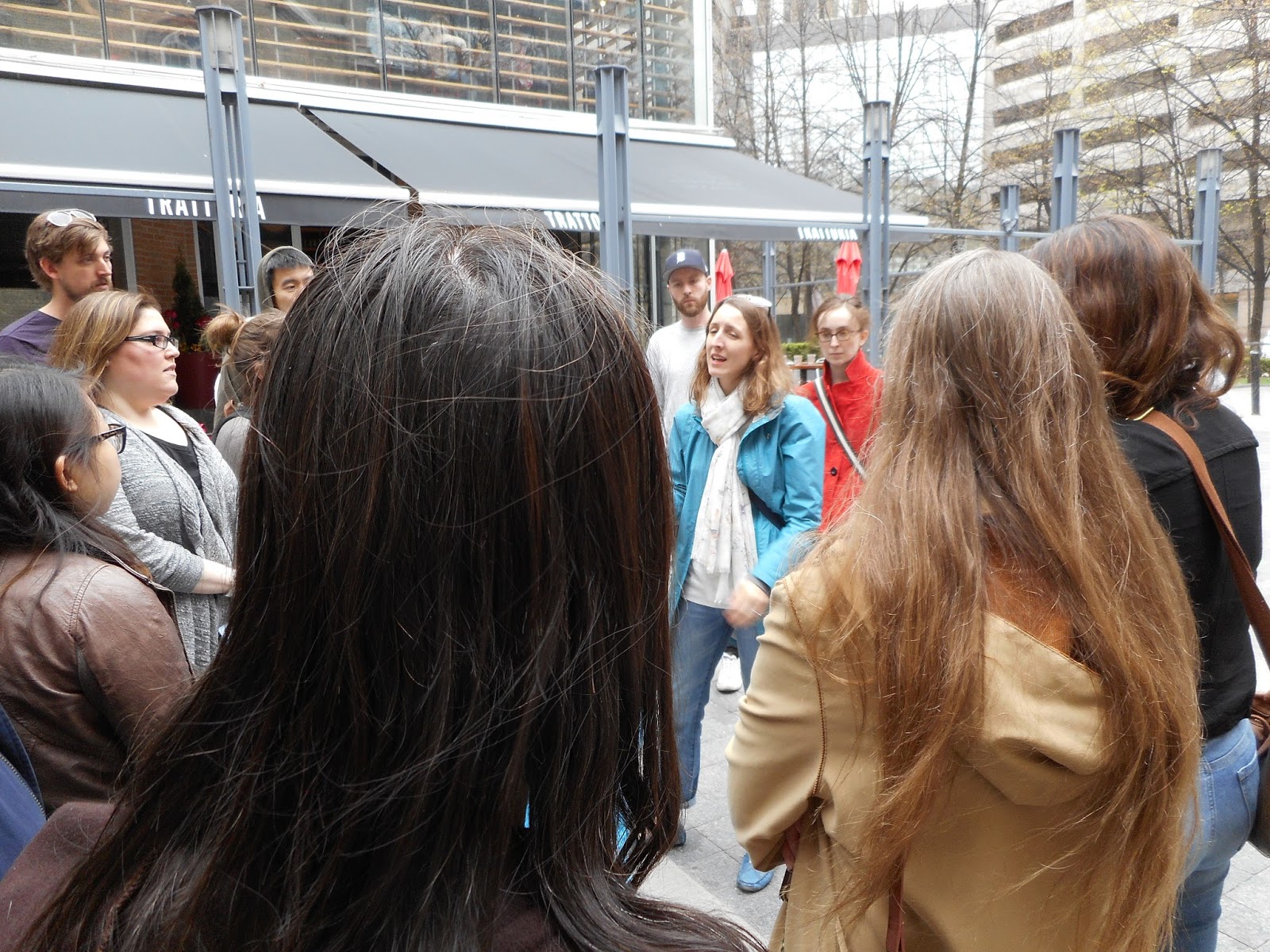
In the photo below, Laura talks about this area:


Then, we were joined by Udo, the nominal host for the walk, who had been delayed, but was able to catch up with us.


After that, it was on to Nathan Phillips Square, where Udo talked briefly about the building of our City Hall in the early 1960s, and then about the now-iconic TORONTO sign, which can be seen in the background:


At the southeast corner of NPS, Udo pointed out one of the new information pillars that have recently gone up, with maps and information about the immediate area. This sign has a feature about the history of the new City Hall.


Next was the Bay-Adelaide Centre, where there is this installation by American artist, James Turrell, called Straight Flush. These are actually openings in the wall, with the colours on the inner panels constantly shifting, as you'll see in my pics for the next walk.
See more about this and other installations at http://www.blogto.com/arts/2014/09/the_top_10_public_art_installations_in_toronto/


Then, it was over to the Design Exchange, which was the site of the original Toronto Stock Exchange, and now is an art and design gallery. You can see that there is a display of various pieces of 20th-century furniture in the background (making me curious to come back here and take a look):


And, away we went, underground, to explore and talk about wayfinding under the downtown. There was discussion about the PATH system (still notoriously difficult to use, in my opinion), and how many of the office buildings have their own signage up, alongside/despite the PATH signs.
Udo remarked how small the printing was on these signs, and it's a fair point. In the Royal Bank Plaza, for instance, there are very clear directional signs, with large print, that make them much easier to use than these more modest ones.


Then down to Union Station (southwest corner of Bay and Front), which is undergoing a makeover of its own. Udo pointed out that Union Station, designated as a Heritage Building, cannot be altered itself, but new additions can be made over and around it, which is what's happening.
He also mentioned the new signs, here and at York St., which are easy to read, large enough, and weather-resistant (one of the themes we discussed on the walk was the durability and relevance of maps, signage and information).


He also pointed out this information pillar, which is temporary during the renovations, and will eventually probably look like the one that we saw at Nathan Phillips Square:


Finally, going into Union Station, I decided to get a pic of one of the maps of the PATH system. Udo had pointed out that the maps themselves look lovely, very geometric and all, but the system itself is, as I said before, very hard to use, with many ways to become lost. Take a look at any of these maps (if you dare), and try to find an easy way from the Eaton Centre to Union Station.
I myself looked closely on this map for a "you are here" sticker (it should be near the bottom, to left of centre), but there was none to be found!

There are hand-held maps available, but they're not easy to find.
I have one, but only stumbled on it by accident in the north lobby of the Royal Bank Plaza!


4:00 p.m.

The second walk I took in was on the theme of hidden works of art in public places. Our guide was Ran, who works at City Hall in planning. This her introducing the walk:

She at least had a microphone, but the speaker kept dropping in & out! The best laid plans...


We met at the Cloud Garden on Temperance St, between Yonge and Bay. Ran pointed out many features of this small park, particularly the tribute to workers, shown here.
Each filled square represents a different material, design or pattern used in construction, as a tribute to the workers who make the buildings you or I use every day. I assume in nicer weather, the creepers on the lower wall look quite attractive.


Then it was across the street, to the Bay-Adelaide Centre, and the same darn installation I had seen on the earlier walk, James Turrell's Straight Flush.
This time, though, you'll note that the colours have changed dramatically; they are set to a timed cycle, so that you can literally stand there and watch as they evolve.


We headed one building east, to see this fascinating installation, in the south side of the lobby of an office tower still partly under construction:


It's a black circle, about 30 feet in diameter, set into the white wall...


...which are both constructed of thousands of individual, hand-made ceramic tiles!
They are not painted - it's two different colours of tile set together to form the contrasting pattern, as you can see in this closer picture.
The piece is made to match another one on the north side of the lobby...



...which is kind of a "negative" of the first one, a black outline of the same size, but all in white...


...and made the same way, with painstakingly constructed and set tiles, as this zoom shot shows.
Remarkable!


Next, we walked to a space between two buildings, south of Adelaide, in between Yonge and Victoria Sts. Here, Ran heads toward the installation, entitled Synthetic Eden, the first part of which consists of these clear panels with organic shapes etched in them:


The centrepiece of the installation is these three sculptures, representing the life cycle of plants; at right, roots; centre, a blossom; and left, the stump of a dead tree:
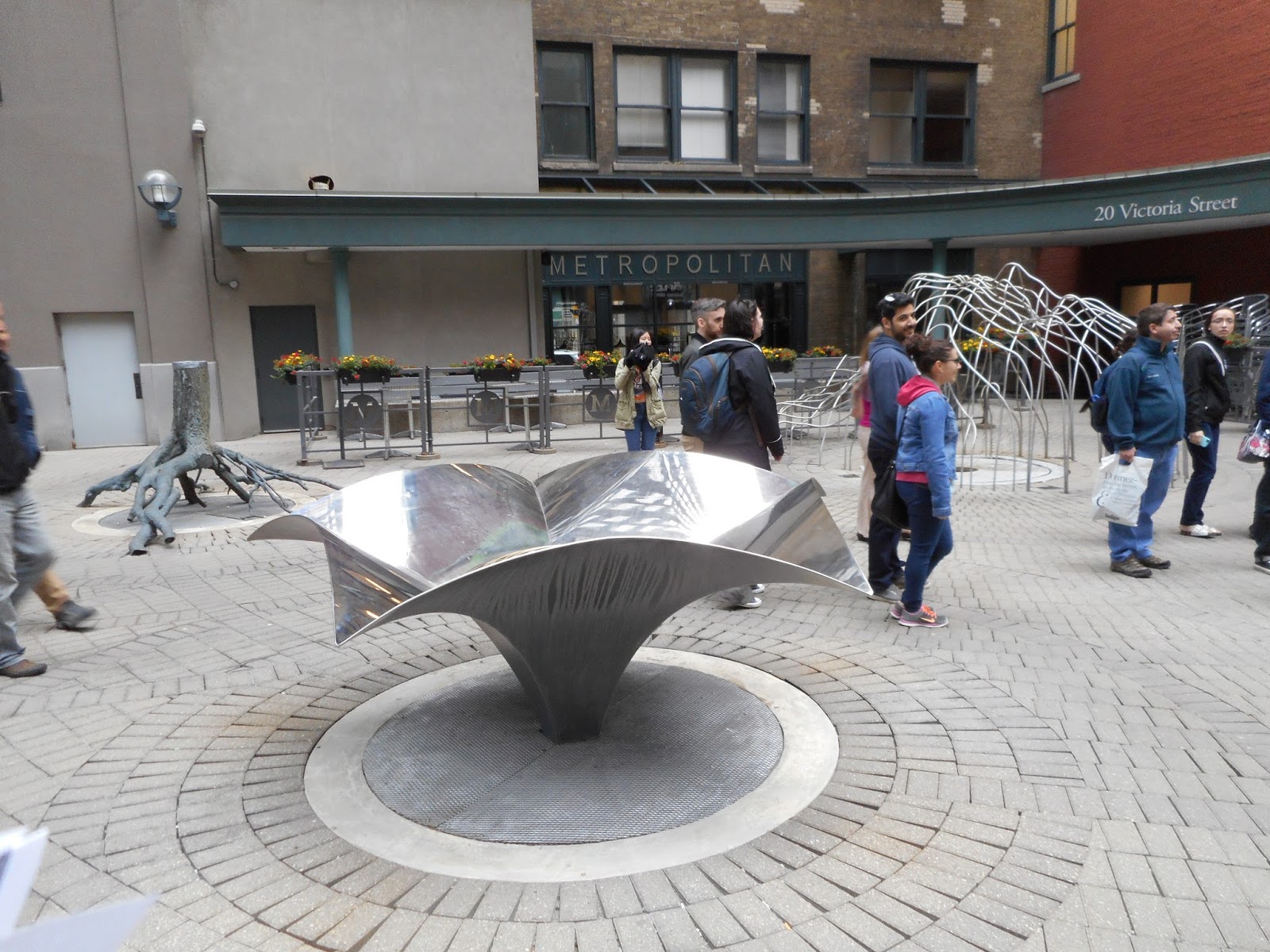


Here are the same sculptures, from a different angle:


And finally, this piece on the wall represents biodiversity; looking closely, you can see all kinds of animal life depicted.
There's kind of a "garden of Eden" theme, with the serpent winding through the centre of the whole thing:


Our next stop was Courthouse Square, the site of Toronto's original courthouse (and in the past, of many public executions). There are different features here, with a common theme of "law."
To the left in this shot (looking south) is a water sculpture; then a bench, with legs made of giant books, presumably "law books;" and finally, a monolith with a human-sized opening, one side of which is labeled, "The Laws of Nature," and the other (not visible), "The Laws of Man":


Then, looking east, you see a kind of arbour, and a stone plinth (near centre), with more of the stylized "law books" on top:


Heading south on Church St., to just south of Front, there is this sculpture, Shoreline Commemorative, with a tripod shape supporting a globe with colours and lighting representing water and sky.
The bottom part, under our feet, represents the actual topography of Lake Ontario, which, if you didn't know, used to end at this exact point, just south of Front St.!


Sandblasted into the brick wall is this inscription, which, if you can't make it out, reads, in part:
"For 10,000 years, this was the location of Lake Ontario's shoreline.
"This brick wall stands where water and land met..."


Then, we headed towards Yonge St.,where, at Brookfield Place, there is this installation, called Garden Court. It's a circular oasis of evergreen trees...


...where you're welcome to go in and sit on any of the ten large boulders surrounding a circular reflecting pool at the centre.
As you can see, it was raining at this point, but thankfully, it didn't last.

(Post office building, on the south side of Front St., is visible in the background.)


Next was the Air Canada Centre, where the Maple Leafs and Raptors ( and many musicians) play.
On the east side, there is this installation, called Wins, Losses, Ties.
Looking up, you see these metal tubes, each with a number inscribed in the bottom...


And looking down, you see these inlaid panels. Each one represents a decade in the life of the Toronto Maple Leafs, divided into seasons of play. When you match the circular incisions to the numbers on the poles directly above, you get the statistics for each season, i.e., wins, ties, and losses!


Here is a closer look at the first decade of the Maple Leafs' existence. You can more easily see how it works. And, they do make note of Stanley Cup wins - though I guess the last 40 years have been pretty blank!


Finally, going through the ACC to the west part of Maple Leaf Square, there are two more sculptures/installations to be seen.
In the foreground is John McEwen's Search Light, Star Light, Spot Light, metal cones with star shapes cut out. Apparently it's lit from inside at night, and looks pretty spectacular.
In the lower background is Soheil Mosun Ltd.'s Connection, a lighted footbridge between two buildings. It also changes colours. like Straight Flush.


Look for more information on these (and other public art installations) at: http://www.torontofunplaces.com/toronto-fun-blog/36-air-canada-centre-wins-losses-ties-sculpture


Conclusion

Well, this afternoon was certainly an eye-opener for me. So many discoveries! As I mentioned above, there were many more walks than these that took place over the weekend. One person could certainly not take them all in!
In the past, I guess TWMVC concerts, or weather, or something, prevented me from attending Jane's Walks, but now that I know how interesting, fun and inspiring they are, I will definitely seek them out and participate in the future.



Sunday, 10 April 2016

Keith Emerson


Along with many other people, I was shocked and saddened by the terrible death of Keith Emerson at the age of 71. It's officially been ruled a suicide, due to a bout of depression he was suffering due to the loss of the use of two of the fingers on his right hand. I remembered hearing, a few years ago, that he had a bad case of carpal tunnel syndrome, and I guess it got that much worse, to the point that he virtually couldn't play music. I can't begin to imagine that things got so bad that he felt he couldn't go on, but there are many more people better informed about these things than I am. Suffice it to say, it was tragic news to me.


In this post, I will be taking a personal look at some aspects of the work of Keith Emerson, one of the most influential musicians in my life. What I mean by that is that the sheer force of his playing, his virtuosity and humour, with influences there for all to see, steered me to many styles of music and composers that I may not have discovered otherwise.


Style

First of all, he was a strongly rhythmic player, with a love of  Latin, honky-tonk, stride, barrelhouse and blues music that showed in his composing and improvising. He also introduced me to some unusual time signatures, most notably, 7/8 time, and I learned to recognize the variations on that rhythm in the music of Genesis, Yes, Frank Zappa, Rush, and many others. He would constantly change time signatures, too, in his improvisations, which really kept me guessing. When I don't know where a song or a piece is going next - that's the kind of music I love.

He also used chords and intervals that I hadn't heard before, most notably fourths. This is an interval that is usually used to create tension near the end of a musical line, because it sounds a little "off," but is then resolved to a third, to bring the line to an ear-pleasing conclusion. Emerson (and again, others in the progressive rock field) used the fourth to dramatic effect in melody and chording, not resolving it in order to create a more arresting, perhaps "primitive" sound (it's no surprise that, as a 13-year-old, I used to listen to Emerson, Lake & Palmer's self-titled first album while reading Robert E. Howard's Conan the Barbarian books!)

The one problem I do have with his playing is the extreme speed he seemed to want to play at much of the time. It was like he was in a rush to get to something else, and notes got lost. I often thought, if he could have slowed things down slightly, it would have been much easier to appreciate his genuine virtuosity.


The Moog Synthesizer

I had heard the Moog synthesizer in music prior to ELP's, but had no idea what it was. Believe it or not, the first use of the instrument that I heard was on the Monkees' 1967 LP, Pisces, Aquarius, Capricorn & Jones Ltd., in the songs "Daily Nightly" and "Star Collector." On Mike Nesmith's "Daily Nightly," it's used as more of a tone generator, to create "spacey" effects, but on Goffin & King's "Star Collector," it's actually a solo instrument, kind of a quirky organ, which is what I thought it was at the time.
The Beatles also used it, fairly extensively, on Abbey Road, mostly in the background, on such tracks as "Maxwell's Silver Hammer," and George Harrison's "Here Comes the Sun." Once again, for all I knew, it was an organ of some sort.

What Emerson did, on that first LP, was bring the synthesizer up front, using it as a major instrument, rhythmically and as a solo instrument, due to his early mastery of it as a keyboard, not merely a novelty. Listen to the layering of them in the last (7/8) section of "Tank," and how he solos effortlessly over that rhythm.
The standout track, of course, is Greg Lake's "Lucky Man" (which he has admitted to writing when he was 12 years old!), which benefits both from his own reverb-laden production, giving it a mysterious quality, and the astonishing synthesizer solo at the end. Emerson's virtuosity in using notes at the top end of the range of the simple three-chord structure of the song, as well as the justly famous swoops and slides (portamenti) that the instrument was capable of, gave the song an otherworldly quality that's still affecting today. This was the piece that made me really sit up and want to know what this instrument was.
Emerson would go on to use the synth in various ways in later LPs, always getting a new, unique sound out of it.
He also helped develop and use a polyphonic synthesizer (meaning you could play more than one note at a time, i.e., use chords), which can be heard on the albums Brain Salad Surgery and Works. This instrument is the gargantuan (roughly 4 ft. by 4 ft.) panel that he was using when I saw ELP at Exhibition Stadium in 1978. It's an unbelievably complicated-looking thing, with wires, switches and knobs galore, and I can only imagine the work it took to use it.

(Side note: There is a terrific young musician named Rachel Flowers who plays ELP's music on the original instruments, like Hammond organ, and that enormous polyphonic synth, in her home. You can find her many postings on YouTube. I was astonished to discover that she's been blind since birth, which makes her talent that much more amazing. Do check her out.)


His Influences

As I hinted above. Emerson never hid his musical influences, doing entire pieces based on works by well-known composers, or I suppose, at least those that caught his ear.
Hence, we have the album-length performance of Mussorgsky's Pictures At An Exhibition, an abbreviated version of which I saw them do at the Toronto concert I mentioned above. He also did rock versions of two of Aaron Copland's pieces, "Hoedown" and "Fanfare for the Common Man," not to mention the amazing version of Ginastera's "Toccata" (from his First Piano Concerto), which also featured Carl Palmer using a type of proto-drum synthesizer in his solo section.
Perhaps the most well-known tune he did with The Nice, prior to ELP, was a version of "America," from Leonard Bernstein's West Side Story. He apparently even throws some Dvorak into this piece for good luck!
And, let's not forget one of ELP's best-known songs, Lake's "I Believe In Father Christmas." As a bridge between verses, Emerson plays a bit of the Lt. Kijé suite by Prokofiev (popularly known as "sleigh ride" or "troika"). It adds a nice upbeat touch to an otherwise rather cynical tune.

Hearing all these pieces made me curious to go and check out the originals, and, for example, I was fortunate enough to see Aaron Copland conduct the Toronto Symphony Orchestra back in the early 80's at the then-Ontario Place Forum. They opened with "Fanfare," (an exhilarating piece in its original form), as well as "Rodeo" in its entirety, among other popular pieces.

ELP also adapted many classical composers' pieces for their own songs. On the first album, for instance, "The Barbarian" is based on Bartok, and "Knife-Edge" on Janacek - both of whom have become composers whose work I have come to admire.

Emerson seemed to have soaked up music like a sponge, and would quote many other composers  (like Bach, in "The Only Way," and "Knife-Edge") or insert snippets of popular music as he improvised. This leads me to my final point...


Humour

Some people have found ELP's music ponderous, or pretentious, but it was never without humour.
From Tarkus on, there was always a lighter-hearted piece of music on each album: "Are You Ready Eddy?" on Tarkus is a tribute to their recording engineer; "Benny the Bouncer" on Surgery is a darkly humorous ditty about a pub fight between two hooligans; and they do a raucous version of Kim Fowley's "Nut Rocker" (itself based on Tchaikovsky) to lighten things up at the end of Pictures At An Exhibition.

As mentioned above, Emerson would also throw in bits of other songs as he went along. Other (British) musicians did this, too - David Bowie and Genesis both quoted The Drifters' "On Broadway" in songs of theirs, for instance, and Rick Wakeman quotes a bit of Bizet's l'Arlesienne on The Six Wives of Henry VIII - but not to such an extent as ELP.
Thus, you can hear a bugle call during "Are You Ready, Eddy?"; fife-and-drum music in "Abaddon's Bolero," from Trilogy; "Short'nin' Bread" is quoted in "Hoedown"; and in "Karn Evil 9: Second Impression," from Brain Salad Surgery, there is a bit of Sonny Rollins' "St. Thomas." This is used in a section that features a synth sound that is very similar to a steel drum, and maybe that's what made Emerson think of that Caribbean-style tune.
Also, as mentioned, the Dvorak he quotes in "America" is from the 9th Symphony, a.k.a., "From the New World" - get it?
There are many more examples, most of which I'm sure I wouldn't know; these are just a few that I recognize.

On YouTube (again!), there's an amazing transcription of Emerson`s "Piano Improvisations" from Welcome Back, My Friends, ELP's 1974 triple LP live album, that names the pieces he quotes, right on the sheet music. Oddly, I heard a snippet of "The Star-Spangled Banner" that isn't mentioned there, but perhaps they considered it too obvious. In any case, it's amazing to see Emerson`s music written out.


Conclusion

I don't guess I'll ever be able to emphasize enough how much of an impression Keith Emerson made on my young, musically curious mind. Perhaps he is the most influential rock musician I've ever known. Judging by some of the comments I've seen in various YouTube postings, I'm not the only one who owes him a debt of gratitude for expanding my musical horizons.
I can only speculate what my musical explorations would have been like without him, but I'm pretty sure they would have been much more difficult, and much less rich and varied.

So, thanks, "Emo," and RIP.


Sunday, 3 April 2016

George Martin: The True Fifth Beatle - and More

Hello again! It's been a while since I posted anything here. Various choir concerts and Easter have occupied recent weekends, but I wanted to write about two recent passings in the music world that meant a lot to me.


First, I'd like to focus on the brilliant George Martin, a producer/arranger/musician I've admired for many years, mostly for his truly groundbreaking work with the Beatles, but also for another couple of albums that are still among my favourites.

In the next post, I'll talk about Keith Emerson, another hard-working musician whose work had a large impact on my musical tastes and explorations.

But, to George Martin first...


"The Fifth Beatle"

In the interview published in Playboy magazine around the time of John Lennon's untimely death, the interviewer asked him to comment on the classification of George Martin as "The Fifth Beatle." To my dismay, Lennon arrogantly dismissed his contribution, saying things to the effect of, "Tell me one song George Martin wrote - please." This was manifestly unfair, and has bothered me ever since.
Not to disparage the memory of St. John of the 'Pool, but there are so many Beatles songs that wouldn't have sounded the same, or barely existed, without what George Martin wrote, or played, or contributed, it's hard to know where to start - but I'll mention a few:

Instrumental Solos and ensembles:
George himself plays the brief Baroque-style piano solo on John's "In My Life." It sounds a little "harpsichordy" because the solo is actually sped up slightly to match the key of the song.
The French horn solo in "For No One" is also a great addition, adding to the melancholy feeling of one of the great break-up songs.
And the piccolo trumpet solo in "Penny Lane," playing against the straight rhythm of the song, is a perfectly eccentric addition to a song about childhood memories of eccentric people.
And don't forget about the delightful clarinet ensembles in "When I'm Sixty-Four," or "Honey Pie." Those songs wouldn't be nearly as charming without them.

String arrangements:
What would Paul's songs like "Yesterday," "Eleanor Rigby," or "She's Leaving Home" sound like without Martin's string ensembles? Think of the held high A note in the last iteration of "Why she had to go, I don't know, She wouldn't say" in "Yesterday," or the rising echoes of the strings to the words, "Where do they all come from?" and "Where do they all belong?" in "Eleanor Rigby." They wouldn't sound the same without them, would they? Think of the hundreds of covers of "Yesterday": are any of them really as affecting as the original?
To give credit where it's due, Paul's singing in all these songs is excellent. Listen to how he bends some of the vowel sounds to give a mournful, weary quality to the words. Another reason they still hold up after (gulp) fifty years.
As for John's songs, with his limited instrumental knowledge, all he could do was suggest the effect he wanted, like an ensemble of some sort starting at a low note and rising to a high one in the two climactic sections of "A Day In the Life." It was Martin who actually wrote the amazing orchestral arrangements, both ending on a high E, that we all know. Also, John only asked for swooping and sliding effects in the accompaniment of "I Am the Walrus." George Martin arranged the string and vocal ensembles to give life to what were only sketchy ideas.
Then, there's "Being For the Benefit of Mr. Kite," a song which would not have the same effect without the "mad circus" sounds created by taking snippets of stock calliope/carnival sounds, literally throwing them in the air, and then splicing them together for some truly unheard-of effects. Again, Lennon suggests; Martin delivers.

George Martin also guided the Beatles in recording techniques, starting at two-track recording, to four-track, to eight-track, along with overdubbing practices that enabled them to create a sound that was so advanced, it couldn't be replicated live.
Throughout, his signature was always a clean, clear, balanced sound, without undue interference. To see what I mean, listen to Abbey Road (especially the ensemble vocals on "Sun King" or "Because"), then to Let It Be, which was produced by Phil Spector. The difference is quite noticeable.


Other Albums

George Martin produced other artists, of course, including comedy ensemble The Goons (pre-Beatles),  Cilla Black, and the folk-rock group America, among others. I won't speak to these particular artists, due to unfamiliarity, but there are two albums that I am familiar enough with to comment on - the two jazz-influenced LPs Jeff Beck put out in the mid-1970s, Blow By Blow and Wired.

Both albums benefit from Martin's clean sound, but, in particular, the string arrangements on Blow By Blow  merit comment:
The last section of the tune "Scatterbrain" launches into a 9/8-time figure played by Beck and his three-man ensemble first, but then they are joined by a string ensemble, playing the same figure. Then, there is a break, where Beck plays another repeating riff, and then the song slowly fades out, with the strings returning to that 9/8 figure, as Beck solos over them. It was the track that ended the first side of the LP, and it's very effective.
My favourite tune on the album, though, has always been the last one, a version of Bernie Holland's "Diamond Dust." To this day, I remain intrigued - and thrilled - by the main theme, an angular yet lovely melody, apparently in 5/4 time. It is moody, melancholy, uplifting and fascinating all at the same time. The string ensemble is very much present here, but the highlight is at the end, where it takes over completely (save for Richard Bailey's drums), and Martin arranges the melody into - wait for it - a fugue (not a word you associate with rock or jazz) to bring the album to a finish on a lush chord (don't ask me what chord it is - my ear's not good enough to tell. But it is beautiful.).
It's just magical - I never hear that ending without wishing the song would keep going! One of the greatest "late-night" tunes anybody ever did.


Well, those are a few of my thoughts on the late George Martin - for me, a seminal figure in rock music, and someone who lived a long, productive, amazing life.
It is his touch that makes the Beatles' music, as well as those great Jeff Beck albums, live on for music lovers.


Monday, 25 January 2016

Thoughts on David Bowie Part II

In the last post, I shared my impressions of David Bowie as a musician, with some musings about the albums I was most familiar with, from Space Oddity to Heroes.

In this post, I'd like to talk more about this multi-faceted man, with some thoughts about his acting roles, live performances and the David Bowie Is... exhibit. These are once again personal observations, and thus limited to my own recollections and impressions.


The Movie Roles

The first (and really, only) lead role David Bowie had was in Nicolas Roeg's 1976 cult flick, The Man Who Fell to Earth. The role used Bowie's own natural diffidence to advantage, as he played an alien who takes the form of inventor/entrepreneur Thomas Newton. Newton is trying to finance his return to his water-starved home planet, but is soon seduced by (pardon the pun) earthly pleasures, particularly alcohol, and ends up stranded here.
The best aspect of the movie, for me, is his relationship with Mary-Lou, played by lovely Candy Clark. In once scene, he accompanies her to church, where he struggles to sing "Jerusalem" with the rest of the congregation. I had to smile when I saw that; imagine, David Bowie having trouble carrying a tune!

Since then, Bowie appeared in various roles, many of which I can't comment on too extensively: The Hunger, where he played John Blaylock, one half of a vampire couple (with Catherine Deneuve). I've only seen this film once, and quite a few years ago; Merry Christmas, Mr. Lawrence, playing a British POW in a WWII Japanese camp. I have never seen this movie, though I hear he is very good*; Just a Gigolo, as as a German WWI veteran who takes up a career as a gigolo to make ends meet; the Goblin King in Jim Henson's Labyrinth, a role in which he showed a menacing edge; Pontius Pilate in Scorsese's The Last Temptation of Christ, which I've only seen once, and I honestly do not remember his performance at all, I'm embarrassed to say; and Basquiat, about the NYC artist, where Bowie played a real person for the first time, Andy Warhol. I haven't seen this one, either.

But there are two roles he played that I do admire (and remember!), one of which I absolutely relish; this was his performance as Colin Morris, aka The Englishman, in John Landis' Into the Night, from 1985. Into the Night is one of my favourite movies of all time; every time I watch it, I'm just delighted. There are many small, quirky performances, including those from other film directors, like Roger Vadim, David Cronenberg, Paul Mazursky, and Landis himself, as well as cameos by Don Siegel, Jim Henson, and others.
There are also musicians in acting roles here, including a turn by Carl Perkins as a big, menacing bodyguard, and of course, Bowie's gleefully psycho gunman, who is convinced that Jeff Goldblum's schlubby Ed Okin is some kind of master criminal! ("You can stop performing now, 'Ed' - if that's your name," he smirks). Later, there is a huge fight scene in a posh hotel suite, between Bowie, Perkins and Goldblum, to the accompaniment of an Abbott & Costello movie on multiple TVs!

The other performance by Bowie that sticks in my mind, though I've only seen it once, is his portrayal of another actual person, Nikolai Tesla, in 2006's The Prestige. He gives the character real depth, with a world-weariness that's quite affecting. Just a small part, but quite memorable, in a movie that I frankly expected to be better, what with Christian Bale, Hugh Jackman, Michael Caine, Scarlett Johansson and Piper Perabo in the cast.


*(Update: I have just recently seen Merry Christmas, Mr. Lawrence on Blu-Ray, and yes, he is very good, as defiant - and guilt-haunted - POW Maj. "Strafer Jack" Celliers. There is even a hint of madness in his portrayal of the character, perhaps a foreshadowing of the thoroughly demented Colin Morris in Into the Night. I had to smile a bit, though, because, as with Thomas Newton, he was again playing a character who is quite tone-deaf!)


In Person/Live

I had the pleasure of seeing David Bowie live once, at Maple Leaf Gardens in 1978, not long after the release of Heroes. This was the concert tour that was captured on the double live album, Stage.
Well, I wasn't disappointed, I'll tell you. The first thing they played were the opening notes of "Warszawa," and from that point on, I was happy.
Bowie was playing no persona here, he was just himself, immaculately dressed, of course, and in fine voice. I remember at one point noting how his voice resonated through the whole of that cavernous venue. Yes, of course it was amplified, but it was still powerful.
He was somewhat reserved and shy in person, seeming genuinely touched by the applause and enthusiasm of the crowd. He was aided ably in the band by his longtime guitarist, Carlos Alomar, who bounced happily around the stage, providing an energetic foil to Bowie's quiet presence.
They ran through tracks from Heroes and Low, as well as older songs, going back as far as Ziggy Stardust. No "Space Oddity," though, and I wasn't sorry (and I'm sure he wasn't, by that time) that they didn't play it.

I also remember seeing a TV special in the 1990s on A&E, part of the "Live By Request" series, that featured Bowie and his band, around the time of the Heathen album. Once again, I noticed his quiet charm and diffidence, as he performed requests for a small audience. It was there that I saw him use the stylophone, which he had played on Space Oddity and The Man Who Sold the World, and was to use again on Heathen. It's a hand-held electronic keyboard, with an octave-or-so range, played with a stylus - hence the name. Only he would showcase such an obscure instrument!


"David Bowie Is..."

I was also privileged to see this exhibit, which ran for some weeks at the Art Gallery of Ontario, one of only a few venues outside of England to show it.
This was an absolutely massive exhibit, ambitiously covering as many aspects of Bowie's career as possible; his hundreds of songs, of course; his early years in London; his influence on music videos; being a fashion icon; his film roles; and more. I spent the whole late morning and afternoon in the exhibit, and had to be chased out by an attendant at closing time!

I already respected and admired Bowie's music for many reasons, but this exhibit increased that respect and admiration many times over.
What was overwhelmingly clear was the massive amount of work the man put into his songs. From his early recordings in 1966-67 on, the control he exercised over his music was amazing.
The exhibit included the copy of The Oxford Companion To Music, from which he learned arranging, as well as several pieces of music manuscript showing his handwritten arrangements for early songs like "London Boys" and "Space Oddity." In fact, there was an entire small room devoted to that one song, showing his string arrangements, contemporary newspapers with headlines about the Apollo missions (where he got the inspiration for the song), and the proto-music video for the first version of it.
There was also a handwritten chart for the vocal arrangements for backup singers for one song on Young Americans. No notation, just a kind of graph showing at what points the voices were to sing the "ooh"s or "mmm"s in the song.
Many people have called David Bowie a genius, mostly since his untimely passing; if anything, this aspect of the exhibit was proof of the humourous definition of "genius" as one percent inspiration and 99 percent perspiration!

I was quite thrilled to see a couple of the (surprisingly basic) synthesizers that were used in the recording of those chilling songs on Low and Heroes. This was part of a room dedicated to Bowie's sojourn in Berlin, and included photos, and some of Bowie's own artwork from that period.

There were also displays of the many stage outfits he wore over the years, with footage of the actual concerts where he wore them projected on the walls behind.

As well, there was a whole room devoted to Bowie's many groundbreaking music videos. We take these so much for granted now, that some may not realize how far ahead of their time some of these were. As I mentioned in the last post, I never saw a purpose-made "music video," promoting a single song, before "The Jean Genie." And let's not forget his innovative video for "Ashes to Ashes," or some of those for his more recent albums, that could well include his last ones, for "Blackstar" and "Lazarus."

Also, there was a small room set up to look like a recording booth, with the walls lined with the full-size covers of all Bowie's albums up to that point (The Next Day had only just been released, and of course, Blackstar was yet to come). It was just overwhelming to think of one person having written all that music, much less performed it, arranged it and toured with it.

There were more things in the exhibit, but I won't try to cover them all. Needless to say, it was an incredible thrill to see the world of such a multifaceted artist opened up to me, and I'll surely never forget it.


Finally...

Want to know the main reason I admire David Bowie? By living his life, he showed that it makes no difference what someone looks like, or their sexual orientation, or their personal demons. In the end, we're all people, and we're all equal.


There will never be another David Bowie.


Monday, 18 January 2016

Thoughts on David Bowie - Part I

On January 8 this year, I posted a tweet on the occasion of David Bowie's 69th birthday, and on the release of his new album - "from a longtime fan."

On January 11, I had to collect my thoughts and send out another tweet, because David Bowie had died.

The massive torrent of tweets and messages was incredible, and showed how many people's lives David Bowie touched. I was a little overwhelmed, because I felt like I had a personal experience of the man that was unique. It was like, "What's everyone else so upset about? I'm the one who really appreciated him." Turns out there were millions of others who felt that way, too.

So, here are some personal thoughts about David Bowie, and the impact he had on my life. I'll focus mainly on his music, mostly on the early albums that I'm most familiar with.

There are other areas that he touched - some that mean more to others than to me - and I will mention a few of them in the next post.


The Albums:

Space Oddity

For my 15th birthday, my older brother presented me with a copy of Space Oddity. On the front cover was a large closeup of a thin, good-looking guy with spiky red hair, and on the back was the same wiry guy, sitting in an effeminate, knock-kneed pose, in a silvery outfit ("Is that a man?" asked our dad. "Yes," we replied, "It's David Bowie." "I thought it was a girl," he said.).

Well, my brother and I listened to that album many times during the rest of the winter, and at first, I admit I was a little baffled by the music. But it got hold of me eventually, and I played the album over and over.
The reason for my bafflement was that I had never heard songs like this before. I was used to the standard "verse-chorus" structure that even the Beatles had almost never strayed from.

I could talk about every track on this album, but two songs in particular really smashed my perceptions of how a song should go:
"Unwashed and Somewhat Slightly Dazed" starts off as an acoustic guitar-accompanied ballad to a snooty rich girl, but (d)evolves into a jaunty tune with full accompaniment, and a Bo Diddley rhythm, not to mention some of the most surrealistic lyrics you can imagine: "And the Braque on the wall/Slides down your front/And eats through your belly./It's very catching," being just a small sample.
Then there's "Cygnet Committee," a song I still find intriguing after all this time. It begins with a quiet instrumental intro, with bass, electric guitar, and electric harpsichord (played by pre-Yes Rick Wakeman.) It slowly builds to a higher and higher pitch, with lyrics that appear to be about a band of revolutionaries, to a kind of apocalyptic climax (even borrowing Dylan's phrase "desolation row" at one point), and an ending about hope ("I want to believe that a light's shining through somehow"), with Bowie keening at the end, "I want to live...live...live" over and over.
I remember saying to my brother about the song, "It doesn't really go anywhere," This was not a criticism, but an observation - perhaps even an epiphany. This was new territory for me; a nine-minute song that had no structure (save for a brief return to the opening verse), but was so powerful and affecting that it still moves me forty years later.

It was years later that I discovered that the album had been made over, circa 1972, as Space Oddity from the original 1968 album, Man of Words/Man of Music, due to the huge popularity of the "Space Oddity" single in '72.
A similar thing was to happen with Bowie's next album, for various reasons. And that leads us to...


The Man Who Sold the World

This was an album with no less than three different covers. The initial 1970 one, and the one that most are probably familiar with now, features Bowie, replete with shoulder-length hair, reclining sideways on a divan, in a unisex dress.
This was a bit too much for the powers that were, and the cover that was released for the reissue in 1972 (and the one that first made its way into our household) featured a black-and white photo of a heavily made-up Bowie with guitar, pouting at the camera while doing a high kick. The back cover was another high contrast black-and-white photo of a silhouetted Bowie singing and playing his omnipresent twelve-string acoustic.
The third cover consisted of several rather crude-looking cartoons, vaguely related to some of the songs on the album. The 1999 CD release has a couple of these in the insert. But it was the black-and-white cover that I knew best, and it seemed to exemplify well enough the eccentricities of the Bowie persona I was becoming familiar with.
As for the music, this was the first album to feature the three-man band that would be with Bowie for the next three releases: Mick Ronson on guitar, Trevor Bolder on bass, and Mick Woodmansey on drums. The songs were mostly straight-ahead rock, though not without the odd touches (including instruments like recorders and stylophone) that would continue to set Bowie's music apart from the rest.
The track that will stay with me, though, is the quiet "After All." I had always liked it, but it also had an effect on another member of our family - our younger brother. He was to die very suddenly at age 25, and his grief-stricken friends remembered how much he liked the song, so it ended up being played at his funeral.
The title track of the album is also notable for having been covered in the 1990s by Nirvana. I can't say I cared for their version; it was just a straight reading of the song, and lacked the unsettling and mysterious qualities that I liked in the original, like the background guiro (another unusual instrumental touch), and the distorted vocals.


Hunky Dory

Then came Hunky Dory, perhaps the most upbeat and happy album of Bowie's early career. He had gotten married, and had a son, variously named "Zowie" or "Joey." (He is now known as Duncan Jones, and is the respected writer/director of such movies as Moon and Source Code.) The cover again features Bowie with long hair, in a hand-tinted "glamour shot," - I've heard it referred to as "the Garbo cover."
Many of the songs are about contentment and home life, like "Eight Line Poem" and "Kooks," a song for his son about getting prepared for an unusual life.
On my most recent listen through the album, I happened to listen particularly closely to "Eight Line Poem," and was struck by the sweet, soulful guitar solo that Mick Ronson contributed to it, as well as to his flowing string arrangements throughout the album, and was saddened that he, too, had left us at much too young an age.
This album also once again featured Rick Wakeman on piano, and he adds a lot of flourishes to some of the songs, especially "Life On Mars?" and "Fill Your Heart."
There are stranger songs as well, of course, like "Quicksand"; also, odes to Bob Dylan and Andy Warhol; and one rocker, "Queen Bitch," featuring Ronson's unique "metallic" guitar sound, which would come more to the forefront on the next release.
The closing track is "The Bewlay Brothers," a contemplative track featuring, again, some very odd lyrics, almost as if he had used William S. Burroughs' "cut-up" technique: "And our talk was old, and dust would flow/Thru our veins, and Lo! it was midnight/Back o' the kitchen door/ Like the grim faces on the Cathedral floor." The song is considered to be about Bowie's brother, Terry, who was in and out of mental institutions for many years, and who would also die young. The song was apparently meaningful enough to Bowie that he was later to publish his songs under the rubric of "Bewlay Brothers Music."


Ziggy Stardust

The next album my brother was to bring home was probably Bowie's most popular and accessible, right up to the 1980s, and Let's Dance. This was The Rise and Fall of Ziggy Stardust and the Spiders From Mars. It's a concept album about (again!) the end of the world, and the arrival of an alien musician, who ends up being killed by his own fans (one of Bowie's personal fears - that, or a plane crash). Again, mostly straight-ahead rockers, with simple instrumentation - Ronson's "metallic"-sounding electric guitar, and some saxophone work from Bowie.
The "second side" of the album, starting from "Lady Stardust," and ending with "Rock'n'Roll Suicide," is a true, coherent suite of songs, like the "second side" of the Beatles' Abbey Road, and stands along with it as a great achievement in emotional and musical range. Probably the best-known song here is "Suffragette City," which is a great up-tempo rocker, but lyrically, shows someone in great desperation. Perhaps it reflected Bowie's own state of mind, which climaxed with him announcing, at the end of the tour for this album, that he wasn't going to play live anymore.


Aladdin Sane

The creative juices kept flowing, however, and Bowie was to produce an album next that looked back on that tour, particularly the U.S. segment, and gave us Aladdin Sane. Everyone knows the cover of this one, featuring Bowie with closed eyes and the now-famous (cliched, almost?) "lightning-bolt" makeup.
It's full of impressionistic lyrics about (again) Andy Warhol, or cities like Detroit and Hollywood. "Panic In Detroit" stands out, due to its chugging (again) Bo Diddley rhythm, wailing backup singers, and lyrics about riots, abandoned cars and suicide.
There are also cover songs, of Bowie's own "The Prettiest Star," and a frenetic version of the Stones' "Let's Spend the Night Together."
An interesting addition to the arrangements was the presence of free-form pianist Mike Garson, who adds a striking contrast to the tight rhythms of the title track, and a beautiful, flowing, dreamlike accompaniment to the final track, "Lady Grinning Soul."
The most well-known track, though is "The Jean Genie," apparently a song about Iggy Pop. I recall seeing David Bowie being interviewed on TV, as he arrived in Canada on tour. I remember well his modesty and graciousness for those few minutes, and it's stuck with me ever since. Then, they played something I'd never seen before - the music video for "The Jean Genie."


Pin Ups

The last album Bowie was to do with "The Spiders From Mars" was Pin Ups, which my buddies derisively referred to as his "contractual obligation album." This was true in a sense, as Bowie was fulfilling his final obligations to the mismanaged MainMan organization which had represented him for some years. But it doesn't mean the album didn't rock like hell; it was blazing covers of some songs that Bowie had heard in London clubs in his teens. The likes of The Who, The Pretty Things, The Kinks, and others were represented.
The standout for me was a cover of "See Emily Play," the early Pink Floyd tune. It got me curious to hear more of their early stuff, and I've been a huge Syd Barrett fan ever since. I even borrowed Bowie's term "Syd's Pink Floyd" to distinguish between pre- and post-Barrett when talking about the Floyd.


Diamond Dogs

The next album he was to do was Diamond Dogs, which had a kind of "post-apocalyptic" theme, and borrowed some concepts from Orwell's Nineteen Eighty-Four, including a song with that actual title. The musicians are kind of "Bowie and backup," including longtime collaborator Herbie Flowers on bass, who had been on Space Oddity, as well as the Bowie-produced/Ronson-arranged 1972 Lou Reed classic, Transformer.
There is lots of good rock music on this album also, including the driving "1984," and the most well-known track, "Rebel Rebel," which features one of the great rock guitar riffs, and to my mind, is Bowie's answer to the Stones' "Satisfaction." Seriously, listen to them side by side sometime!


David Live

Bowie was to tour again after Diamond Dogs, and this is when he created his next persona, "The Thin White Duke," who wore zoot suits and fedoras, and where Bowie completely changed his musical style. This was "blue-eyed soul," which obliged him to change the sound of his voice, from the glam tenor of Ziggy Stardust to a rich, resonant baritone. I will admit that the album that came out of that tour, David Live, was a bit of a head-scratcher for me. It featured complete reworkings of his classic songs to suit the new "soul" sound, and I wasn't sure it all worked. I also thought his voice was very rough-sounding - as it turned out, this was the worst period in his life for drug problems, and that may have contributed to it.


Young Americans

The album that came out next was the formal introduction of this new persona, and was called Young Americans. This was all-soul, all the time, and featured his next hit, an early disco number, "Fame," co-written with album collaborator, John Lennon, also in the midst of drug (and marital) problems. This was the first album to feature guitarist Carlos Alomar, a bundle of energy who would be with Bowie for many years. It also included David Sanborn on saxophone, who would go on to many more collaborations and solo work, not to mention a young Luther Vandross.
The album also has a cover of Lennon's "Across the Universe," which, though much different from the Beatles version, holds its own as a more stripped-down, emotional reading.
When I hear some of these tracks now, I think I appreciate them more than I did at the time. My friends would say, "Why does he change his sound so often?" and I would reply, "Why not? He's looking for something new," but to be honest, I was feeling less enthusiastic as a fan myself.


It was around this time that Bowie took on his first major movie role, that of stranded alien (surprise!) Thomas Newton, in The Man Who Fell to Earth. I will talk about Bowie's acting career in another post, but scenes from this movie would appear on the covers of his next two albums...


Station to Station

Station to Station came out just as I was finishing high school, and there was a big hit from it on the radio, "Golden Years." My friends again dismissed it as a disco song, but I kind of liked the smooth, polished sound of it, and didn't consider it "disco" at all. I bought the album, and was impressed with the title track, with the "train" sounds at the beginning, and the changing tempi and time signatures (as well as some very offbeat lyrics). Having developed a liking for progressive rock, this was something I could get into! Some of the other tracks, like "Word on a Wing" or "Stay" were less enthralling, at the time.
The album grew on me through my post-secondary years, though, and I came to like it. Particularly outstanding is the final track, a passionate rendition of Dmitri Tiomkin's "Wild Is the Wind," that showcased Bowie's newfound soulful voice like never before.
In retrospect. Bowie was getting more sophisticated - but I wasn't. At that time, I was wondering whether I would feel enthusiastic enough to buy his next album. Well, life is full of surprises...


Low

I heard things about Bowie's next album that were intriguing: "He's taking a new direction." "He's got a new sound."
At a party I went to, things were winding down, and I crawled into a bed upstairs for the night. There was a radio in the room, and they announced a track off Bowie's new album. I didn't get the title - it sounded like some foreign language - but through my drowsiness, there came the most incredible piece of music I'd ever heard.
The next day, I raved to my friends about the song I'd heard, and as soon as I could, I went and bought the album. Another still from Man Who Fell on the cover, I noted, having seen the movie sometime before.
After the buzzsaw opening to the first track, "Speed of Life," I thought the songs weren't that different from before. There were synthesizers aplenty, which was a plus (I was, and still am, a huge fan of the sound of analogue synthesizers), but they were mostly uptempo, poppy tunes.
Then, I turned the LP over, and there was the song I'd heard: "Warszawa." From the opening drones of that piece, chills ran up and down my spine, and barely let up until the last track on the album. It was raw, haunting, despairing, chilling music, and subconsciously, I may have realized that it brought me back to those first "unstructured" songs on Space Oddity that had caught my attention years before.
The "lyrics" in two songs on the second side ("Warszawa" and "Subterraneans") were also a source of puzzlement. I sure couldn't make them out. As it turns out, they were merely meaningless syllables that Bowie sang as melodies. They are very effective, in any case, in adding another layer to the mysterious and enigmatic music.
I also noticed that the main collaborator on the album was someone I had been admiring for a while, Brian Eno. I had some of his albums at that time, Here Come the Warm Jets, Discreet Music and Another Green World, and had been fascinated with the things he did with music. Not only did he write incredibly clever and weird lyrics, he also did things with instrumentation and arrangements that were new and unique. So it was no surprise to me that he had helped Bowie achieve something new and brilliant.
This is my favourite David Bowie album, and one of my favourite albums ever. It still gives me chills.


Heroes

The next album to come out was also recorded during Bowie's "recovery" in Berlin. The striking cover was apparently (like that of Iggy Pop's The Idiot) loosely based on a painting he had seen in a Berlin art gallery.
Musically, at first, it seemed quite similar to Low, with faster, more mainstream tracks on the first side, and introspective, synth-laden instrumentals on the second. It again featured able assists from Brian Eno, and some of the (Side 2) tracks had a similar feel to those on Low. But this album ended with an uptempo piece, co-written with Eno and Carlos Alomar, "The Secret Life of Arabia." It was like Bowie was becoming more positive and hopeful, after the bleakness of the previous release. Mind you, there is still plenty of dark stuff here, like "Joe the Lion" and "Blackout."
The album also featured another personal (ahem) hero, guitarist Robert Fripp, a collaborator with Eno at least since Here Come the Warm Jets. His work on the title track is noteworthy for its keening, sustained notes, set atop Bowie's tight rhythms - in a way, invoking Mike Garson's work on Aladdin Sane.


And the Rest?

I will stop here.
I did get several of Bowie's later albums, including the third in the so-called "Berlin trilogy," Lodger, as well as Scary Monsters, Let's Dance, and others. Through the 1980s, though, my musical explorations turned more to classical music, and working in a record store enabled me to inexpensively purchase box sets of operas and symphonies that I felt more inclined to listen to at that time.
Then, CDs appeared, and I slowly started to replace my old, scratchy. pop- and click-laden LPs.

In 2000, there was a fire in my apartment, and many of my LPs (and some CDs) were damaged enough that I didn't keep them. Since then, I've been more selective about what music I buy, and since the advent of DVDs, I have collected more movies than music. What with cable TV and the internet, there are more options for entertainment now than I can get my head around, and collecting music is only something I do occasionally, when something really catches my ear. The last time I bought rock CDs in any number was during the grunge era!

I have heard some tracks from Bowie's last album, Blackstar, with the title track being particularly haunting, and will probably pick it up, once the frenzy for his albums dies down. (I was working in a record store at the time of Glenn Gould's passing, and you'd think, from the crowds that filled the place, that they weren't going to press any more of his albums, ever!)


I do have more to say about David Bowie, though, and in the next post, I'd like to talk (more briefly, I hope) about his film roles, seeing him live, and the David Bowie Is... exhibit. Stay tuned.


Sunday, 10 January 2016

Words We Don't Use Anymore Part II

Happy New Year! Thank you for coming back to my blog. I will try to post thoughts/events/pics as often as I see fit again this year, and hope you enjoy them.

I thought I'd start off another year the way I started the blog last March, with a word that I find charming or quaint, but that is not widely used. This time, the word is:

Nigh, literally "near," or "almost." With origins in Old English, this word is only used poetically nowadays, as the word "near" means virtually the same thing. but has come to have more versatility.

As an example of its poetic or lyrical sense, we still use the word whenever we sing the Christmas carol Away In a Manger: "...and stay by my cradle (or, side un) til morning is nigh," depending on which version you use.
As a kid, like many others, I used to sing this song in Sunday School, but would think, "Pssh! Silly writers! They mean "til morning is night - they've just left off the last letter!" Ah, the certainty of youth! Of course, "til morning is night" doesn't make any sense, since you're asking Jesus to stay with you through the night, not through the day. "Stay by my (whatever) til morning is near," is what it means; it just took many years (and lots of reading) for me to figure that out.

Well, nowadays, you might see the word as the answer in a crossword puzzle (which is what inspired me to write this post), but in popular usage, it's well-nigh obsolete (bazinga!).


Wednesday, 23 December 2015

My Fortnight With Shingles


During the first two weeks of December, I experienced a case of shingles.

When you hear about shingles, they're usually someplace on a person's torso, but the gods blessed me with a breakout on the left side of my face. Unlike what you hear, in my case, it wasn't painful - at least I was spared that - but it wasn't fun, and it sure wasn't pretty. I will treat you to some pictures of the progression later in this post; something to look forward to!


The Onset

Naturally, at first, I had no idea what was happening. The first symptoms began to show towards the last weeks of November; I felt aches and pains in the bones in the left side of my head, mostly around my jaw. My teeth in that area were quite sensitive, but I dismissed it as "cold weather" sensitivity. Later, I was to discover (thanks, internet!) that these were signs of neuralgia (literally "nerve pain"), a common symptom of the onset of the illness.
As you know if you've read this blog, I am a member of the Toronto Welsh Male Voice Choir, and on November 28, we held the first of three scheduled Christmas concerts. The concert went well, and I was planning to attend the customary choir afterglow at a local pub. On stepping outside after the show, though, I began to feel extremely tired. I was with another choir member, and we decided to get something to eat, then head home. I had also been noticing redness in the skin on the left side of my face, and asked if he noticed it. We both wondered what it could be - eczema, maybe? No, I had had a bad case of that as a child, and mostly remember the terrible itchiness that accompanied it, which, thankfully, wasn't happening here.

All the way home, I felt more and more fatigued, and was quite exhausted by the time I got in.
The next day, I noticed that the left side of my face was starting to swell up, and decided I'd better get to a doctor.


The First Week

Monday, I went to a local walk-in clinic, where the doctor looked at my face, and diagnosed me as having shingles. She assured me that it wasn't unusual for it not to be painful, so at least there was that. She prescribed two medications, Valacyclovir for the shingles, and Cephalexin, an antibiotic.
I was also sent to an ophthalmologist, since my left eye was quite red, and while I waited, I took the first dose of the medications (these were not cheap, by the way - the cost of both medications was nearly $200). The ophthalmologist found no issues with my vision, and off I went home

After I got home, it occurred to me that I should take a picture to document this experience (if anyone should doubt it), and did a bathroom selfie.
Just for contrast, here's a pic I had taken just a few days earlier and posted to Twitter to show my Movember 'stache, which I would shave off early, because my face was getting more and more swollen:


And, here I am on Monday afternoon:


Looking at this pic now, I can't believe I actually went out in public looking like that! Eurgh!

The doctor I saw at the walk-in clinic warned me that the symptoms could get worse before they got better, and boy, was that an understatement!
Shingles is essentially the chicken pox virus, lying dormant inside those who get chicken pox as a child, then showing up again as you get older. So, as with any virus, there are attendant symptoms such as fever, chills, weakness and fatigue. For most of Tuesday and Wednesday, I slept, either in my chair or in bed. I didn't have much of an appetite, either; I would take a few bites of something, and feel nauseous, then immediately flop down again, exhausted.
Also during this time, the area under my left eye got so badly swollen that it was easier just to close it and use my right eye if I wanted to see something.
As you see in the picture above, my upper left lip was also swollen up, and it got so bad that I couldn't open my mouth the whole way. Plus, the whole left jaw area eventually swelled up to near-tennis ball size. You can imagine how difficult this made eating and drinking, and as the week progressed, that area of my face became dry and encrusted, making things even harder.
All the quotidian things we take for granted had to be rethought. Shampooing in the shower wasn't possible, and I didn't dare shave my left upper lip for the whole two weeks; once the scabs receded, I had to keep the whiskers trimmed with scissors. Flossing? Forget it. Brushing? Just barely.

I didn't lose hope that the symptoms would go away soon, though. The choir had two more Xmas concerts to do, and I was determined to make the next one, the weekend of December 5. Unfortunately, the symptoms persisted, and - well, I was fooling myself, really; they weren't going anywhere, and neither was I.

As a precaution, on Monday, I had done some extra grocery shopping, and had enough to eat for that week, but by Saturday, I was running short. I was over the flu-like symptoms, and my appetite was returning, but now the outbreak on my face was starting to turn into reddish-black scabs, and I looked worse than ever! Fortunately, a very good friend, who lives nearby, was able to bring some groceries, and a box of surgical masks which I had requested, to my place on Saturday. I was over the contagious phase of the illness, so no issues with visitors, but as I mentioned, I looked like hell, and the masks would allow me to get outdoors without, at least, feeling too self-conscious. I made hot chocolate for my friend and I, and we had a nice chat.
I've been on my own for many years, and like to feel that I prefer it that way, but when you're completely alone like this, you realize how much you do miss other people. I sure was glad to have some company!

Well, by Sunday, I realized that I would need at least another week for things to clear up, and called work to say that I would need that much more time off.


The Second Week

On Monday, I went back to the walk-in clinic, just to see how things were progressing, from a professional's point of view. I felt better every day, though progress was slow, and was able to get out in public with a surgical mask on. The receptionist at the clinic (who must see sick people all the time) was quite shocked by my appearance, which made me glad I didn't try to go back to work, or to get out more than I did.
The doctor told me to finish off the antibiotic pills I had been prescribed the week before, and prescribed Bactroban, an antibiotic cream that I could apply to the scabs and surrounding areas, to ward off possible infections.

Here is what I looked like for that whole week:

You can understand why I wanted those surgical masks, right?

I still had limited energy, and needed rest and recuperation more than anything. But my appetite was improving, and I could get the groceries I needed on my own now.

Early in the week, my regular GP's office called and suggested I make an appointment. The earliest they could take me was Friday (which was why I chose a walk-in clinic in the first place). By this time, a lot of the scabs had come off, though there were still plenty, and there was starting to be an itch on the clear areas. The doc prescribed a lotion to combat the itch, and suggested I put Vaseline on the scabs to soften them up and help them come off. This turned out to be the best suggestion of all, as that's just what was needed to clear things up over the next few days.

Sadly, I had to beg off the next (and final) Xmas concert that the choir was doing, that Saturday the 12th. I still didn't feel "presentable" enough, and was still easily tired.
I got a call from one of the guys that week, with a very generous offer of monetary assistance from some choir members for the time I had to take off work. I assured him that I have some savings that I could use to cover the lost wages, but was deeply moved by this gesture.
Also, I had rented an instrument from a music store to play for these concerts, and was unable to return it while I was ill. When I did get it back to them and explained my situation, they said they had already taken the next month's rent out of my credit card, but would refund the difference, in cash!
As I write this, I am still touched by the kindness and sympathy shown to me by friends and family, and strangers, during this difficult time.

Then, it was back to the ophthalmologist again, for follow-up. She found no problems with my vision, which made me feel more confident and happy than I had for a long time.


It's Not Over...

By the second weekend (12-13 December), all the scabs had come off my face, save for a small one near my eye, and I was able to go back to work on Tuesday. I put in full days the rest of the week, and was even able to enjoy the company Christmas party that Friday. Even between Tuesday and Friday, co-workers were remarking how much better I looked.
My appetite and energy increase every day, and I feel able to do all the things I used to, though I don't push myself. Happily, there are no vision or muscular problems as a result of this illness.

There is still a tiny bit of swelling and reddish skin on the left side of my face as of today, December 23. Part of my upper lip and some of my teeth on the left side are still numb, like a dentist's freezing. The downside is that the itching is more of a problem - actually, it's weird; the sensations range from itching to numbness to aches to tingling. It's sort of like when your leg falls asleep, and as the circulation comes back, you have these different sensations - only it's happening way more slowly than that.
I have trouble getting to sleep at nights, when there are no distractions, and my focus shifts to the itching in that area. I try to think of other things, and eventually do get to sleep, but it can be fitful. My eye is pretty much fully open, but still a little red, and alternates between being itchy and being sore. Thankfully, I still have lots of that lotion to relieve the itch, and am now reconciled to the fact that this is going to take its own time to fully heal.


Finally...

This was one of the loneliest periods of my life. I really appreciated the sympathy and encouragement from friends and family, but I felt so very isolated. I even felt despair at moments - which, thankfully, soon faded - that I hope I never feel again. I can't imagine how it must be for those with a chronic illness, or shut-ins, who truly can't get out, and may not see an end to their troubles.

Perhaps I, and anyone who reads this, can show a little more empathy towards people who are genuinely less fortunate, especially in this season.

And on that note, Merry Christmas - Feliz Navidad - Joyeux Noel - Buon Natale - Froehlich Weihnachten - to everyone. Thank you for reading this blog; I look forward to posting more in the new year.