It was a cloudy day, unfortunately, and quite chilly, despite a forecast for nearly the exact opposite. The sun barely showed until after the event was over, in fact. But it didn't stop me from getting out and getting lots of pics.
It occurred to me partway through the day that the main places I chose to visit were buildings I had actually been in before, with only one exception. But it had been so long that many of them had undergone extensive renovations, making it a great opportunity to catch up.
If you follow my blog, you know I'm captivated by beautiful churches, though I practice no religion myself. I'm mostly interested in the architecture. Having been privileged to see some amazing cathedrals in Paris (Notre-Dame) and England (Bath), I love to contrast our own to them, and am usually pleased to note that they do compare quite nicely!
So, when I found out that St. Paul's Anglican and St. Michael's Catholic churches would be part of the event, I couldn't wait to get to them.
First of all was St. Paul's, on Bloor St. E., just east of, appropriately enough, Church Sreet.
As mentioned, I had dropped in here some years ago, just out of curiosity, and had been impressed by its size and beauty.
There has been a St. Paul's in Toronto since 1842, and this "new church" was opened in 1913. It was co-designed by E.J. Lennox, famous for Old City Hall and Casa Loma.
From across Bloor St., you get a good view of its main entrance, with three porticos and three large windows, all in Gothic style:

Upon entering the church proper, this is what you see: the nave, with Gothic arches on either side, and seating for 1300.
It's much brighter now than I remember from my visit decades ago ( though I could be misremembering, too).

The three Gothic stained-glass windows above the chancel depict various stages in the life of Jesus, and are quite colourful:

Lower down, under three Gothic arches (perhaps all the threes are references to the Holy Trinity? Are you thinking, "Duh... of course"?), are the altar, and an ornamental screen known as a rederos, carved out of alabaster:

A closer look shows the altar, and the central part of the rederos, beautifully detailed, including a carved depiction of the Last Supper, with Jesus holding the goblet of wine that represents his blood:

And, of course, if you follow my blog, you know I just have to have a pic of the organ in any church. As with many others in Toronto, this is an enormous Casavant Freres creation. Sadly, we didn't get to hear it played.

At the other end of the nave is the baptismal font, with a carving depicting the biblical passage where Jesus says, "Suffer the little children to come unto me."
(Speaking of children, you may notice a small sticker at the bottom right; there were several of them set out in various places for children to find, as an activity on the self-guided tour).

At the east wall, there is this remarkable window, called The First World War Window. It is partially constructed of stained glass collected by a Canadian intelligence officer, Brig.-Gen. C.H. Mitchell, from various churches throughout Europe.
These were not plundered; they're fragments from churches that were partially or totally ruined in the war, that were unable to be reused.

Next to the windows was this remarkable guide, showing where the fragments were collected.
It's quite poignant, heartbreaking even, to think of such beautiful work being thoughtlessly and carelessly destroyed for the virtually zero gains made by anyone from the entire four-year war.

Here, from the inside, are two of the three stained-glass windows that adorn the front of the church.
The middle one is blocked by organ pipes, which is kind of a shame, but you wouldn't begrudge a church a magnificent organ sound, right?
The eastern one depicts Jesus' call to the apostles in the largest sections:

And the western one shows the resurrection:

At the northwest corner of the sanctuary is this memorial to the Queen's Own Rifles. St. Paul's is the home church of the regiment, and there are several memorials throughout the church to their war dead.

Next to the QORC memorial, over the entrance to the church, is this double stained-glass window, constructed in honour of "the forgotten casualties," the civilians lost in wartime (more than 1,000,000 in WWI).
It depicts a resurrection scene from the Bible, and in the bottom right of the right window is a poignant tribute (see next pic):

It is in memory of Iris Burnside, granddaughter of Timothy Eaton, one of nearly 1200 civilians who perished in the sinking of the Lusitania in 1915.

No exploration of a church is complete without a look at their rose windows.
If memory serves, I got a pic of the west window first:

Then the east window.
As you can see, the tracery is unusually thick around the stained glass, and it was very difficult to make out any specific scenes. But the windows are gorgeous anyway.

And here is a series of shots taken from the chancel.
First, looking toward the north end of the church, the entire nave, with the choir stalls in the foreground. I liked the inlaid marble checkerboard floor pattern in between the choir stalls.

Then, a look at the ceiling, constructed of dark wooden trusses, and quite shallow, in contrast to an ideal Gothic design, which would have the ceiling be as high as possible.
I liked the large, eight-bladed fans, rotating even on a cool day like this one:

Here is more detail of the west part of the chancel's reredos. At centre are lists of the war dead, and there are military and religious figures in rows on either side.

And a closer look at the figures, with very useful name tags, presumably just for this occasion! From top to bottom, we see King George V, Lord Kitchener, and Florence Nightingale.

Then, there is the church's pulpit, known as "the Titanic pulpit."
One of the few male survivors of the Titanic disaster in 1912 was Maj. Arthur Peuchen, a member of this congregation, and of the QORC. He was allowed onto one of the lifeboats of the Titanic, and subsequently, and for the rest of his life, was considered a coward.
One way he tried to make amends was by donating this stunning oak pulpit to the church. It depicts Christ the shepherd, flanked by Christian martyrs.
Wealthy at the time, Peuchen lost all his money through bad investments, and died poor.

Finally, here are two shots of the "old church," from 1894.
First the north transept, now a small chapel, and part of a new annex, which includes a concert hall and gymnasium. You can see the modest rose window, three narrow Gothic windows, and the wooden ceiling trusses:

And, from the outside, there is the rose window, the three smaller ones, the tower, and the small nave of the original building.
 |
| Would have been an imposing building at one time, but not any more! |
Next, it was on to another of Toronto's great churches, St. Michael's Cathedral Basilica, on Bond Street..
They've been working on a restoration for some years now, and as you can see in the picture, it's still not complete. Scaffolding obscured the work for quite a while, but now, you can see almost the entire stunning exterior, with the large central portico, flanked by two smaller doors, and the enormous arched window above it. And note the gorgeously ornamented single tower, one of Toronto's best-known landmarks for many decades.

Inside, you can see that the place has undergone a spectacular makeover, much more colourful and brightly lit than I remember from my first visit some years ago (I believe it was during one of the first Doors Open events, in fact).
This view is looking east, toward the sanctuary and altar, and there is another huge stained-glass window above the reredos.

Each of the transepts in this church are quite modest (i.e., comparatively shallow), but have lovely gilded rose windows.
The north transept also has fine statues of Mary and Joseph:

And the south transept has another gilded rose window, and statues depicting the sacred heart of Jesus, along with St. Jude (the patron saint of lost causes, or desperate cases).

Here's a closer look at the stained-glass window above the altar: it depicts the crucifixion, and is amazingly colourful. It's too bad it was so cloudy out that day; it must be stunning with the sun shining through.

At the pulpit is this gorgeous golden tintinnabulum, apparently one of the symbols bestowed by the Pope to designate the church as a minor basilica. Note the little bell in the centre. The whole thing glistens much more brilliantly than is apparent in this pic.

Near the south transept is this bust of Pope John Paul II, who, as you may know, has recently been made a saint by the Catholic Church:
 |
| I happened to see John Paul II during his 1984 visit to Toronto. Even though he was just going through the crowds in the "Popemobile," he gave off an undeniable air of serenity and goodwill. |
It was at this moment that the organist started up a rehearsal on the church's organ (pic to come), and it was LOUD! So, I turned and got a pic of him, as well as some of the organ pipes, and the west-facing window (also to be seen in a forthcoming pic):
 |
| These pipes at bottom are the chamade, or trumpet chest, and are part of the organ. |

This is a marvelous Pieta, depicting the three Marys at the crucifixion. It is the actual tomb of the three Loretto sisters who assisted the first Bishop of Toronto, Michael Power, in his ministry during the 1840s. Their names are inscribed on the tomb.

Some of the tombs are installed already: Among the square-shaped ones at far left is one for "the unknown construction worker."

Back in the nave, I couldn't help noticing the plethora of beautiful stained-glass windows all along the walls in this church. I just took a pic of one, though, for brevity's sake. It shows the angel Gabriel's annunciation to Mary. Isn't it stunning?

I couldn't help noticing that the pews in the church have been upgraded, also. They look rather comfortable!

At the north transept is the church's baptismal font.
The feature that really stood out was the inlaid, Celtic-style woven pattern on the floor around it. Apparently, there are recurring Celtic decorative features throughout the place.

The choir sits at the front of the church, near the altar, and this is the (relatively modest} choir organ:
 |
| Looks like it can hold its own, though... |
Finally, we were allowed up to the loft level.
On the way, I thought I'd get a pic of the more modern aspects of the renovation, including these shiny stainless steel, glass and marble steps:

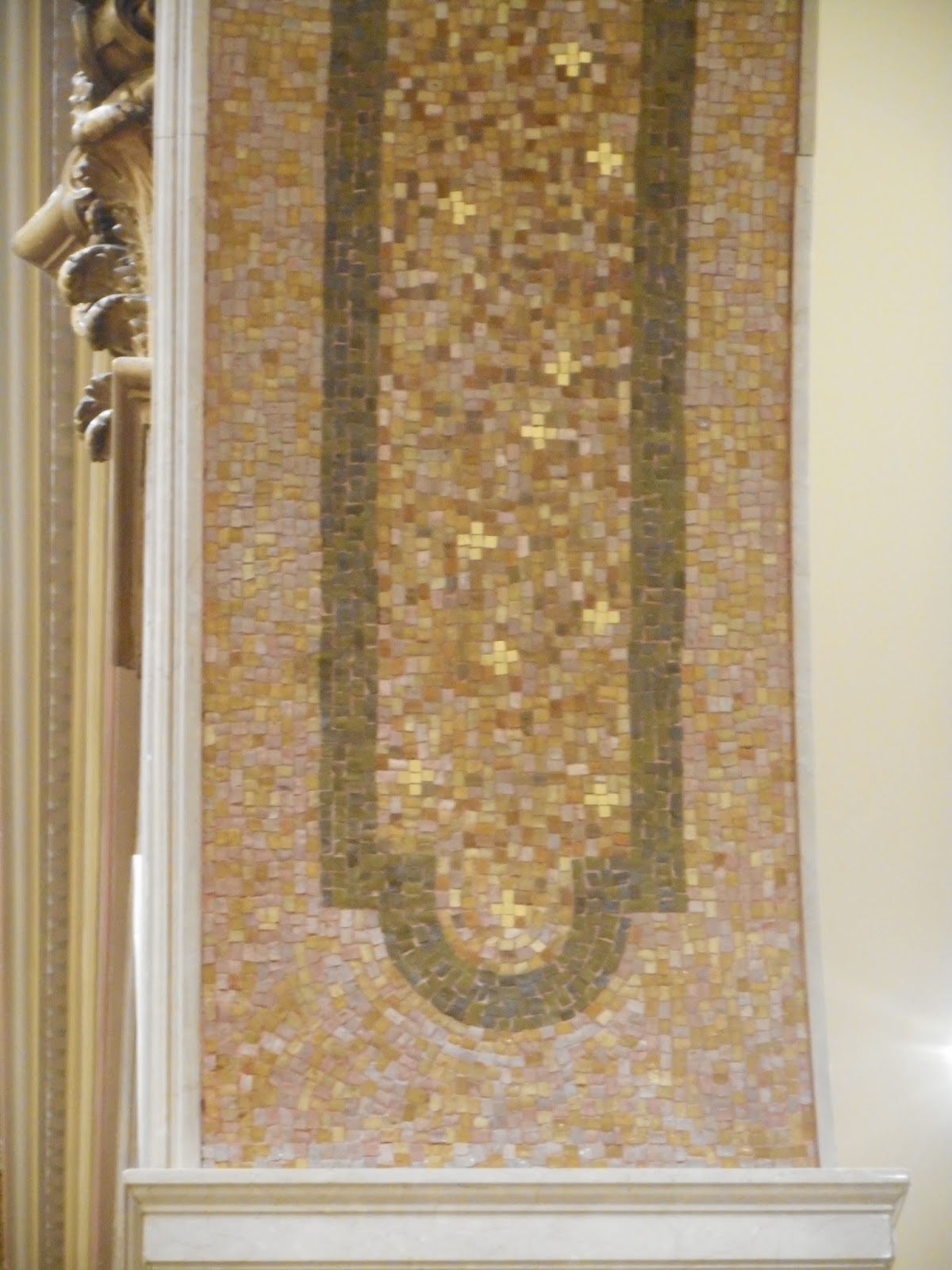
At the top of the stairs, and looking along the south side aisle, you can see the beautifully restored ceilings. They depict the heavens, with a cobalt blue sky and stars, some of them gilded:

Here's a view of the nave from the loft, and it is breathtaking.
The shields on either side of the arches feature mostly religious symbols.

And here is the main organ, and yes, it's another amazing Casavant instrument. It has 75 stops, and more than 4,000 pipes!

This is the west-facing stained glass window, situated over the organ. It's an interesting design, with three rows of simple, almost childlike depictions of various Bible stories, like Cain and Abel, the Tower of Babel, and so on.

Above the window is this medallion, with four Celtic harps in a cruciform shape. It's in keeping with the Celtic motifs throughout the church that I mentioned before.

And, I couldn't resist a pic of another great stained-glass window, as seen from the loft level.
It appears to show the presentation of the infant Jesus to the church, or maybe to one of the evangelists (not my field).
Like the window depicting the Annunciation shown earlier, it's done in a classical style, and brilliantly colourful.

At the top of the same window is this utterly charming rose window that shows an angel playing a stringed instrument. I found it quite captivating, and had to take a pic.

Still in the loft, the view down the north side aisle shows the church's brilliant tabernacle in the sanctuary area.
As you may understand, I thought I should get a closer look...

...so here is the stunning tabernacle in all its golden glory. It's really something.
Of course, as with the tintinnabulum, it's even brighter in person.

Finally, we were allowed into the sanctuary area. Earlier, I had been struck by the wooden statues of the apostles incorporated into the reredos, and finally got a picture.
The reredos also includes three saints (only two visible); Raphael, Gabriel, and I presume the one in the middle is the patron saint of the church, Michael.

It was real treat to be able to see the inside of this great church once again.
Here's a final view of its south side, with all the huge arched windows, the transept, and the tower.
Walking south down Church Street from St. Paul's, I thought it would be easy to spot the spire from a good distance away, but because there are so many tall buildings going up these days, it was actually quite difficult. Guess you can't turn back the clock...

And, from temples of worship to a temple of commerce (Mr. Segue), I wanted another look inside the original Bank of Commerce building, now known as Commerce Court North.
Here's the view from across King St.

Then, a frontal view from the same spot. The building was opened in 1931, and at 34 stories, was the tallest building in the British Empire until 1962!

And a closer view of the main entrance, with a Romanesque arch and classical details for the windows above it.

Inside, there are four murals in total (only two open that day, in the west wing) by Arthur Crisp, on a kind of "transportation through the ages" theme.
The first depicts "modern" travel, with well-dressed passengers of a "monster steam engine of 1930":

Next is a representation of a much older mode of transport, with. apparently, Sir Walter Raleigh directing the loading of a wooden sailing ship in Elizabethan times:

Moving through the foyer into the main hall, we see one of the three massive electric chandeliers, or "electroliers," suspended from the ceiling.
One of the many massive arched windows is in the background.

Here's a detail of the amazing coffered ceiling in the great hall, said to be modeled after those of the ancient Roman bathhouses at Caracalla.
The tour brochure is coy about whether that's real gold leaf or not, but the blue shade is azure.

There were several display cases throughout the hall, but I liked this one showing a model of the building from the time of its construction:

At the south side of the hall is this WWI memorial screen, dedicated to bank employees who lost their lives in that war.
At centre are angels at the altar of sacrifice, and below the dedication, an excerpt from a Rupert Brooke poem about The Great War.

I noticed that the electroliers, though made of bronze, had two distinct colours, and wanted to get a pic. The camera really lightened up the colours, but you get the idea:

Here's a shot of the foyer north from the main hall. The ceilings in here are 65 feet high.

And here's one of the electroliers, all lit up:

A shot from the main hall, looking north, of the west wing, with repeating arches, giving a kind of "infinity" effect:

Here's the barrel-shaped, coffered ceiling in the foyer, with highly intricate patterns.

On either side of the east and west elevator banks are these intricate carvings, depicting flora and fauna. You can make out a serpent lower down, and near the top, a squirrel holding a nut.

I was quite taken with the beautiful etched bronze of the elevator doors. The arched tops show a triple maple-leaf pattern, perhaps related to the symbol on the flag of Ontario:

And there is more etching on the doors themselves, again with the triple maple-leaf motif:

Lastly, at the entrance, are these great bronze frames around the doors that lead into the east and west wings. At top are those symbols of wisdom, owls, and below them, male faces.

And each side of the frames depicts more flora and fauna: oak leaves, corncobs, a lizard (at bottom), and a squirrel, just over halfway up.
They were designed by the building's architects, and represent qualities like thrift and industriousness.

It had been a long time since I'd been inside this building (it is a functioning office building open to the public, after all), but it's always nice on an occasion like this to get a feeling for its history.
Next, it was on to the Sony Centre, a place I became quite familiar with in the 1980s, when I spent a couple of seasons, part-time, as a supernumerary for the Canadian Opera Company. It was still known as the O'Keefe Centre at that time.
They've redone this building recently also, so I was eager to see what was new.
From across Front Street, the modernist building looks the same, with its famous canopy, though it's been cleaned up, and looks quite clean and new.

Inside, there is still the double grand staircase leading from the lobby to the concert hall.
Having been in the Paris Opera House, I saw where they got the idea!

I captured a portion of the huge mural (100 feet wide!), depicting the Seven Lively Arts that hangs above the entrance. Painting, sculpture, architecture, music, literature, dance and drama are all represented here:

Then, big problem: the battery on my camera died! I wasn't sure what to do, as I'd planned to take more pictures, then remembered that my smartphone has a camera - well, it would have to do.
So, a disclaimer: the remaining pics will not be as good quality, but at least I was able to capture what I wanted.

The auditorium looks much the same, but the seats have all been replaced. There's still room here for 3,000-plus patrons.

And the walls look the same, with these raised features:

From the stage (a view I became pretty familiar with) you see that the new seats are a grey colour now. I recall them being red when I was there last.
The acoustics here were never suited to orchestral or operatic music; the stage was discreetly miked for operas! I was relieved when we finally got a purpose-built opera and ballet house, The Four Seasons Centre, and a great one it is.

And, another view I am familiar with: backstage! The wings here were incredibly cramped during opera productions (they run two at a time, so the other show's props and sets were jammed in here), and it made moving around backstage tricky. The one entrance from the upstairs dressing rooms was through that single door you see at left!

Nowadays, the Sony Centre is serving the purpose it was meant for, in my mind: traveling musical productions, like Shen Yun, and concerts, such as the ones coming up by Elvis Costello, Bonnie Raitt and kd lang.
Still, seeing the place again was a great trip down memory lane for me.
Walking up Yonge Street, I briefly dropped in to the Elgin and Winter Garden Theatres, for a look at these famous vaudeville palaces that still host live shows. It was very dim inside, so I didn't get good pictures, until I came out one of the exits.
On the way down the stairs were displayed some things from the original theatres, including this gorgeous Art Nouveau backdrop from a 1920s/30s production:

So, that was the total of the pics I got there. Another time, perhaps?
Finally, I was intrigued by the tour offered at the Arts & Letters Club on Elm Street. I knew the place was associated with some of Toronto's writers, as well as the Group of Seven artists, so I decided to check it out.

The arched doorway still looks pretty impressive!

From the foyer, you go down a corridor to the Great Hall (though it's actually rather modest). They put on live shows and celebrations here, including spring revues by their members.

Above the stage is this painting of a Viking ship, the symbol of the Society, designed by the Group of Seven's J.E.H. MacDonald.

The room was designed to resemble a medieval hall, and to that end, includes these dark wooden ceiling beams, as well as an actual minstrel gallery!

Here's the view of the hall from the minstrel gallery.
What was showing on the screen was a sort of fluid moving cityscape.

A closer look at the remarkable ceiling above the Great Hall reveals the wooden vaulting and beams. Also note the triangular window openings.

Also on the second floor is the library. The books here are either by or about members of the Club, and busts of some of them.
What's that at the right of the picture, you ask?

It's an actual narwhal tooth, donated to the Club by Dr. Henrietta Banting, wife of Club member Dr. Frederick Banting (yes, co-discoverer of insulin), in 1970.

This airplane propeller was donated to the Club by the Royal Air Corps after WWI. The Corps actually had a base on the Toronto Islands during the war!

Finally, some notable paintings on the walls of the library:
The one at top is by the Go7's Arthur Lismer, and the lower one is by none other than Dr. Banting himself!

And, on the other side of the fireplace, among others, are these three paintings, all by members of the Group of Seven:

It was kind of a rarefied atmosphere in here! Very much a "club" feeling, though anyone with an interest can join, for a membership fee.
As I said, I've been curious about the place for a long time, so it was great to get access to it.
Well, that's it for Doors Open 2017. I am posting this late, I know, but things come up (or I get lazy), and I was delayed in finishing it up.
I hope to have a couple more postings in the next little while, about my walk down the lower Humber River Trail, and the Waterfront Festival. Stay tuned!