Well, another year, another Doors Open! This is something I look forward to every spring.
As always, there were many places of interest that I wanted to look at, and as always, I preferred to go to the ones that were within walking distance from my home downtown. This year, I did end up catching the Spadina streetcar to get to the last place, but only because it was someplace I'd wanted to visit for years - The City of Toronto Archives.
The first stop, though, was relatively close by, on Eastern Avenue. I knew the city had repurposed many of the industrial buildings along Eastern over the years, and was curious to see what they'd done with this one, at 433.
As it turned out, the older building, below, had been made part of a city works complex, with newer buildings behind it.
 |
| Other buildings of this type, particularly along Front St., have been made into theatres and police stations! |
What they had on display was some of the equipment that keeps the city working.
In the pic below, clockwise from bottom, a snowplow, paving truck, salt spreader and street sweeper.
The workers there were happy to explain how the machines worked, and if you look at the street sweeper, you may notice it has two sets of controls (pedals, steering wheels) so that one-way or narrow streets can be worked more easily.
 |
| You may also notice the boy at the controls of the sweeper; children were especially fascinated by the equipment. |
Here's a side view of the salter.
Having seen them in operation, I knew that the disc assembly in front of the rear wheels was where the salt was sprayed from.
In the background, you can see a leaf-clearing machine. The jaw-like device on the front opens, scoops up piles of leaves, and deposits them in a dump truck. It was kind of a scary-looking thing!
Not related to Doors Open:
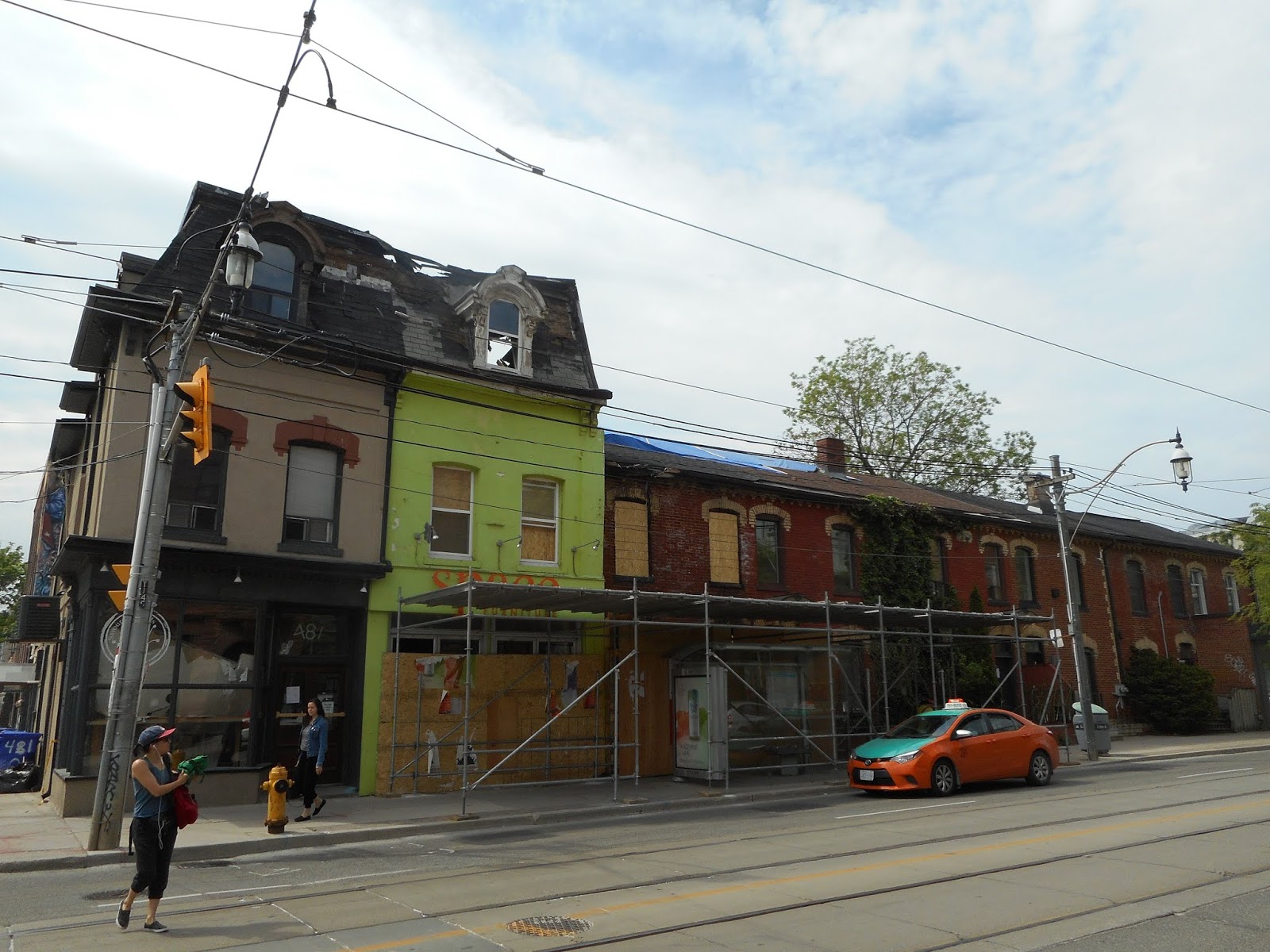
Striking along Queen St., I came across something I'd forgotten about: the aftermath of a horrendous fire several weeks ago that consumed much of three of these lovely 19th-century buildings. Happily, there had been no injuries or deaths as a result - but it's still a mournful sight.
The next stop was Jarvis St. Baptist church, at the corner of Jarvis and Gerrard. I'd been by here many times, and had always been curious what it looks like inside (if you read my blog, you'll know that I like exploring Toronto's many churches).
I was particularly interested by the spire, which is placed
diagonally, facing the corner, instead of one street or the other, like virtually every other church I've seen.
 |
| The main entrance is actually on the side, along Jarvis St. |
At the entrance, a gentleman was giving out copies of this newsletter from 1944 (they apparently had lots left over!) - a special issue which solicited funds for the rebuilding of the church, which had suffered a tremendous fire in 1938.
It offers a guide to many of the architectural features of the building (including photographs and floor plans), and so was a valuable resource for my tour.
 |
| Poignantly, there is a note to "Readers in the British Isles," asking them NOT to send money. As you may imagine, they had much more extensive rebuilding of their own to carry out in 1944. |
On entering the building, you're struck immediately by the wooden pews, altar and choir loft, and the huge array of organ pipes:
Something that sets this church apart is this huge rose window, set into the
ceiling, rather than one of the walls.
It's apparently patterned after the rose window in Westminster Abbey, and is 43 feet across (which also happens to be the approximate size of the north and south rose windows in Paris' Notre Dame). It is lit from above by 500-watt lights (at the brightest points), with 1000-watt lights above them!
 |
| It looks like sunlight, doesn't it? |
Another unusual feature is that the sanctuary is horseshoe-shaped, though there are other churches with this feature in Toronto, like Trinity-St. Paul's at Bloor and Spadina, or St. Andrew's on Simcoe - but perhaps not to this extent.
We were allowed to roam as we wished, and from the arched window at the middle of this pic, I took the next one...
...of the entire sanctuary.
You may notice instruments, chairs and music stands around the altar, and the mixing console in the foreground; they were going to have a concert later that day. I was sorry I wasn't able to catch it.
I was struck by the many Gothic features of the architecture, including these pillars and the high vaulted arches:
And to add to the Gothic feel, there were even gargoyles on the outside, surrounding the main entrance. I love gargoyles!
And, finally, the view along Gerrard St., showing the curvature of the roof to match the horseshoe-shaped interior.
There was another display in one of the adjoining halls, with photos of the 1930s fire and its aftermath. They also very generously were offering free coffee, cookies and bottled water there to visitors, and I was grateful to have a bottle of water to take along for the rest of the day.
The next trip was up to St. Mary St., to St. Michael's College at U of T.
There were several relatively newer buildings on this campus, like Brennan Hall, here:
We could go round the back here, and enter the building from this arched doorway for a look around:
Much of the space here was taken up by this cafeteria. I liked the lamps, the wainscoting and the large ceiling beams.
On the east wall of the cafeteria was this pretty impressive painting, a copy of Guido Reni's 1636 depiction of the Archangel Michael trampling Satan in the victory of good over evil, as depicted in the Book of Revelation.
Visitors were invited to explore this modest chapel next to Brennan Hall, St. Basil's. It was first opened in 1856, but has undergone many renovations, the most recent being the cleaning of the exterior brickwork (finished just last year), making it look quite new!
Inside, there is a long nave, flanked by pillars and vaulted arches.
The inside was painted white - also in just the last few years - and it is quite lovely and bright inside.
Here's a shot of the organ loft at the rear, complete with brilliant organ pipes and a rose window, which you'll see better shortly.
I would have liked to go up and see the organ more closely (something else you know I like if you read my blog!), but I saw a young couple who had ventured up there being quietly escorted out, so I chose discretion over desire.
Over the altar is this beautiful stained-glass triptych window, showing, left to right, the Archangel Michael (looks like he's got Satan pinned down here, too!), St. Basil the Great and St. Charles Borromeo.
And, as promised, over the organ pipes, the rose window, which depicts the Holy Spirit in the form of a dove, surrounded by other religious symbology.
I was quite taken by the bright colours of the stained glass in this modest church - apparently repurposed from clerestory windows over the course of several renovations.
Walking out to the quad, I noticed the stainless steel sculpture and fountain to the right, and was told by some guides to check out the next location...
...which turned out to be the one-time residence of Marshall McLuhan, on St. Joseph St.
He came here from his time in England to teach at St. Mike's, virtually inventing the concepts of media and communication studies.
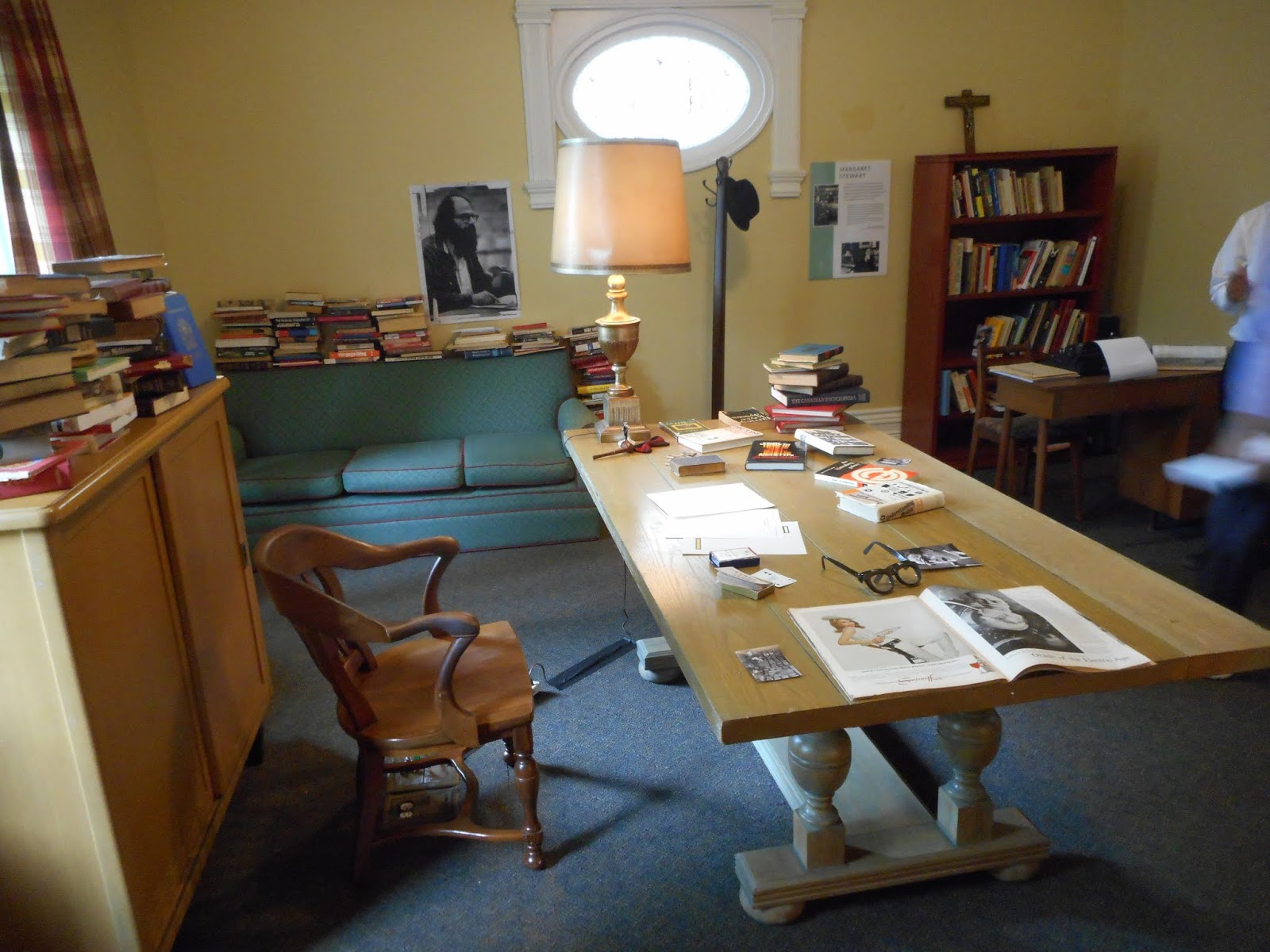
Here is a reproduction of his workspace. There was a very enthusiastic guide there, who pointed out many interesting things, like the desk and typewriter (middle right) used by McLuhan's secretary, who apparently typed what he dictated - he never wrote notes by hand.
When I asked about the copy of James Joyce's
Ulysses on the desk, the guide had another amusing story: Allen Ginsberg (photo to left of table lamp) came to U of T in the 60's for a conference, and asked McLuhan if he'd ever taken LSD. McLuhan apparently replied, "No, but I've read
Finnegans Wake."
Across St. Joseph St. from the McLuhan house is the Kelly Library, a four-storey brutalist structure:
At the time of Doors Open, they were having tours of the library, including talks about these two printing presses:
Unfortunately, I couldn't catch those tours either, but got pics of these beautiful old printing presses, one on the second floor, and this one on the ground floor.
And, I guess this speaks for itself:
Next, it was over to Beverly Street, and the George Brown House, another building I've passed many times and never been into.
It was completed in Second Empire style in 1876, and was where George Brown, his wife Anne and children lived. As you may know, Brown founded what is now the
Globe and Mail newspaper, and was also one of the Fathers of Confederation. One of Toronto's largest community colleges was also named for him.
 |
| I studied computer programming at George Brown College - I wonder what he would have made of that concept? |
The house has undergone many owners and renovations over the years, and here is the dining room, done over in Art Nouveau style around the turn of the 20th century:
I couldn't help but think that these shutters must have been original to the earliest construction of the house:
I was taken by the inlay in the floors: the hallway has tiles, and there is a pattern in wood on the floor of the dining room.
 |
| 'Scuse my feet there... |
And there is more tiling in the ground floor hallway:
 |
| Again, a great view of my feet... |
Here are a couple of views of Brown's study, as it must have looked in his time:
For the library, the Ontario Heritage Trust looked for as many books that Brown actually owned as they could find (about 2,000) to fill these shelves:
The upper floors of the house are presently all offices, and visitors weren't allowed there - but you could take a picture.
You can see the preserved plaster cornices and ceiling medallion, as well as the dark wood banisters and doors.
My last stop (after a ride on one of the beautiful new streetcars up to Spadina Station) was another place I've always wanted to explore: the City of Toronto Archives, on Spadina Rd., north of Dupont.
There was much to see here: An exhibit called "Wide Open World: A Celebration of the Suburbs," a series of photos and text about the opening-up of Toronto's suburbs after WWII; and three huge books where you could look up your street address, and see who lived there in the past (turns out my place has been divided into apartments for at least 50 years).
But the most interesting was a display about the waning days of World War I (a century ago this year), with photos and charts showing timelines and such, but also these original copies of
The Daily Mail and Empire that chronicled the day-by-day news from the war:
 |
| Also, many interesting ads and opinion columns from the time. |
The theme of Doors Open this year was "Film: The Great Romance," and on the second floor, there were many original architectural drawings and sketches of some of Toronto's great movie houses, like the Imperial and the University.
It made me sad to think that all that's left of the University (where I saw
2001: A Space Odyssey (in re-release),
Alien,
The Empire Strikes Back, and most importantly to me,
Apocalypse Now, for which they had to fit a new sound system, and the like of which I'd never seen before) is a small part of its facade, on a high-end store.
It's a shame about the other great ones, like the Uptown and the Eglinton, though it is encouraging that some, like the Bloor, the Revue, the Kingsway, or the Mount Pleasant, are still being put to good use.
Well, back to the Archives: here is something that took my breath away. On the first and second floors, there are large windows where you can see the records centre. It is truly astonishing; there are over 123,000 boxes in here, taking three storeys, or 36 feet, of shelves!
Someone asked one of the guides if these records couldn't all be digitized, but think about it: even at no expense (and there would be expenses), by the sheer volume, this task would take several lifetimes to complete!
 |
| I mean, look at this! Sheesh! |
And, that was Doors Open 2018 for me.
It's always a great pleasure to explore my city's history, and there are always things I don't get to; I just have to hope they'll be open to explore in the future!
In a couple of weeks, the annual Waterfront Festival is happening, and I'm looking forward to sharing photos and thoughts with you on that.
See you then!